

The Pallid Sturgeon, Reflections on Endangerment, Life, and Looking a little Closer..
Warning: Trying to access array offset on value of type bool in /home/b4ey4rbk3gtb/domains/lakesidelabair.org/html/wp-content/themes/LakesideLabAIR17/single.php on line 19
Warning: Trying to access array offset on value of type bool in /home/b4ey4rbk3gtb/domains/lakesidelabair.org/html/wp-content/themes/LakesideLabAIR17/single.php on line 19
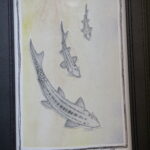
The third week I found myself diving in a little deeper into ecology and science. I joined the aquatic ecology class when they ventured to Vermillion, SD to the Fishery to visit the Endangered Pallid Sturgeons. It was a very moving experience to be able to witness all the various stages of life of the sturgeon in one place. I sketched along the way while taking various notes and ended up creating a piece with the sketches that I did.
The endangerment of animals, plants, and insects weighed deeply on my mind after this. I ended up researching all of the endangered and extinct butterflies to the United States. More and more as I continued to research I found that most of the reasons why the butterflies go extinct or endangered is due to loss of habitat, specifically their host plants. Butterflies typically only have one host plant which their caterpillar stage feasts on. The loss of this plant completely devastates a population. Over the more recent 30+ years, other things that contributed to population decrease would be the use of pesticides, environmental disasters, cars, parasites, and disease.
I thought about what a miracle it is for a butterfly to hatch from its egg, survive through its caterpillar stages then envelop into a vulnerable chrysalis to finally emerge as a butterfly which then migrates thousands of miles to lay its eggs or overwinter… and then comparing it to human life. It is pretty miraculous that we get to be here just like how miraculous it is for a butterfly to live its full life cycle.. There are so many things that could prevent us from growing to our fullest potential in life.. these thoughts brought me great gratitude.
This reminded me why the work I’m doing is important to me seeing those beauties flutter about the skies, prairies, mountains, dunes, swamps, and so many more terrains are so important. They bring joy and pollinate and not only that, but we need the diversity in our species. Losing even one species is losing too much. The little girl who wandered the prairie behind my childhood home catching butterflies would have been so lost without the flecks of colors that wisped around her and from time to time would land on her as if she herself were a brilliant flower.
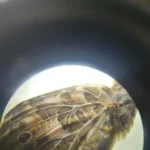
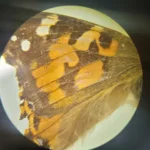
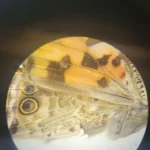
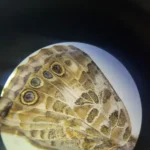
I also was able to borrow a microscope to examine a few Painted Lady Butterfly wings that I had brought with me. It was an awe inspiring to be able to look in depth at butterfly wings and see every little scale on them. It reminded me so deeply of embroidery. This brought many questions to my mind regarding the importance of pattens in butterfly wings to identification and the weathering of the wings over time. -Colors dilute, the wings tatter, the tattered wings affect the flight (making it harder for the butterfly to fly). Not only this, but some things that were on my mind revolved around pattern recognition and abstraction.

“Artists and scientists are both asking questions about the world, they’re just doing it in different ways”
Alex Braidwood
Director, Iowa Lakeside Lab Artists-in-Residence Program
MEMBER
Alex Braidwood
Director, Iowa Lakeside Lab Artists-in-Residence Program

Mailing List
Artists
2025
2024
2023
2022
2021
2019
2018
2017
2016
2015
The Iowa Lakeside Lab Artst-in-Residence program is generously supported by:


Iowa Lakeside Lab | 1838 Highway 86 | Milford, IA 51351