

The world feels big as graduation closes in. I had too much to pack, but I showed up at Lakeside Lab with yarn, wool, a few needles, and a suitcase of unanswered questions, skipping my own graduation. Where do I go? So many factors were deciding whether I could stay in this country, and it all felt daunting and far too real. In a few weeks I would fly home — but what does that mean? My parents recently divorced and I haven’t seen them in years. I left my hometown ten years ago. I am across the Pacific, and the small idea of home feels out of reach.
So my mind wandered as I moved into Lakeside. To the particular blue of the evening in my hometown, which came back to me driving through the optical illusion of Iowa’s far fields. Then farther, backward instead of away: to a basement, years ago, where a girl I didn’t know yet had cool boots. I sat down next to her and asked how she painted them, and learned her name was Maya. I hadn’t seen Maya in three years. Everything seemed so small at Oberlin, during Covid, when it was just us. And then the world became big. Maya travelled the world and I went to Dartmouth.
The kettle hole
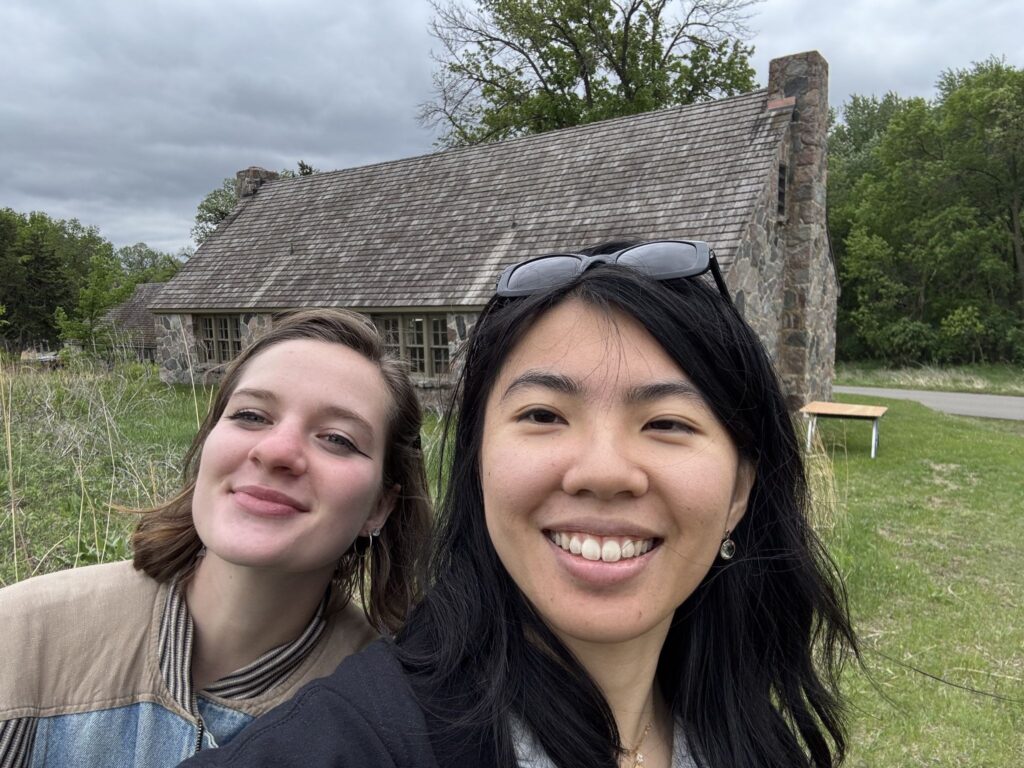
The first afternoon, Maya and I walked to the kettle hole to lie down in the grass. I had been picturing it for months — the ground softly catching me, something finally familiar. Nature always brings me comfort in the transient periods of life. What I didn’t know was that the kettle hole belonged to other small creatures. One on my ankle, one on my wrist, one I didn’t find until the shower. I was practically chased out by ticks.
What small and persistent creatures ticks are. There’s a whole colony of them at the kettle hole. The place must already feel big to them — but if one latched onto me and rode back to Lakeside, and eventually out of Iowa, that must feel enormous. A fifteen-minute car ride is crossing the Pacific, in a tick’s eyes. All of a sudden I felt a kinship with the little creature. Imagine a kettle-hole tick leaving home and finding itself in completely foreign land. A tick diaspora.
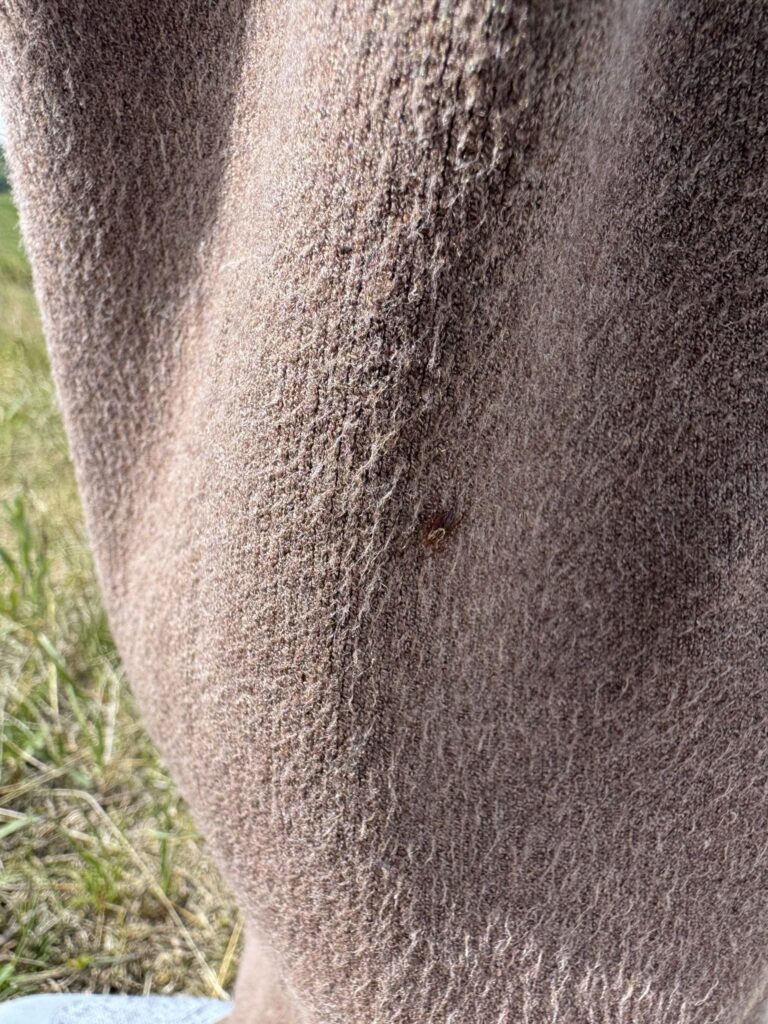
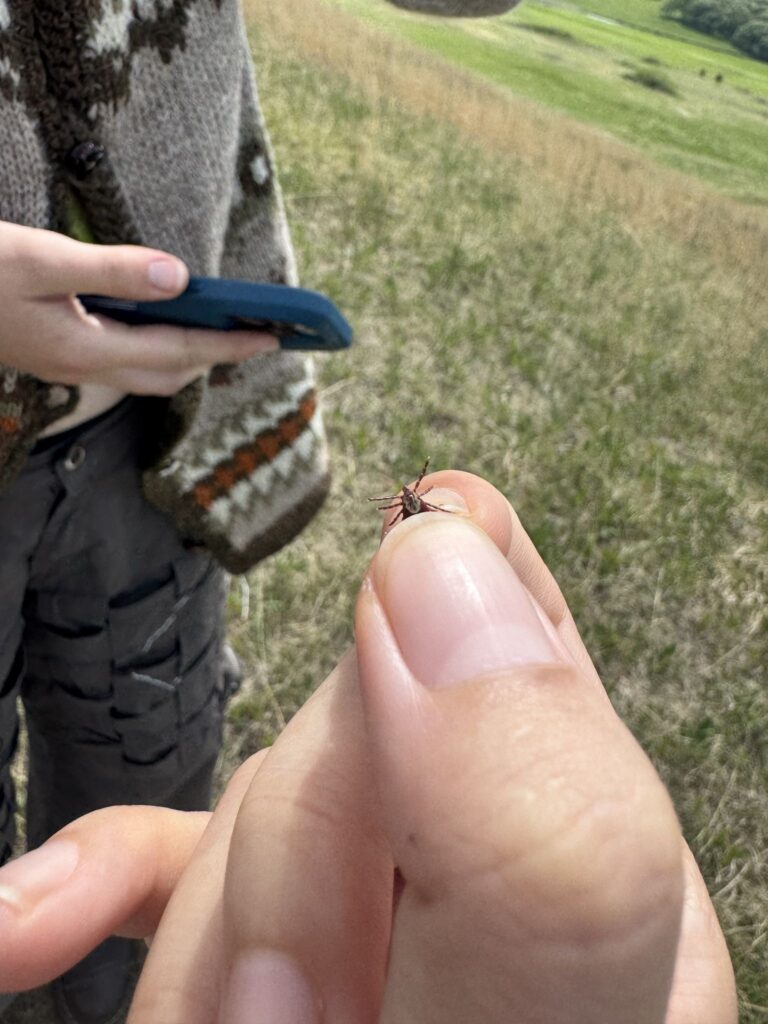
If I no longer feel safe in the grass, the tick might. If I find the tick and pick it off, it must feel very out of place, right?
Far and near, where I feel home is, I began to wonder: what does shelter mean? What does belonging mean?
Glass houses
One of the diatom researchers let me sit at a microscope with a jar from the lake, and there they were: tiny glass boxes. Wheels. Ribbed boats. Zigzag chains linked end to end like a necklace someone had let slip off the dock.
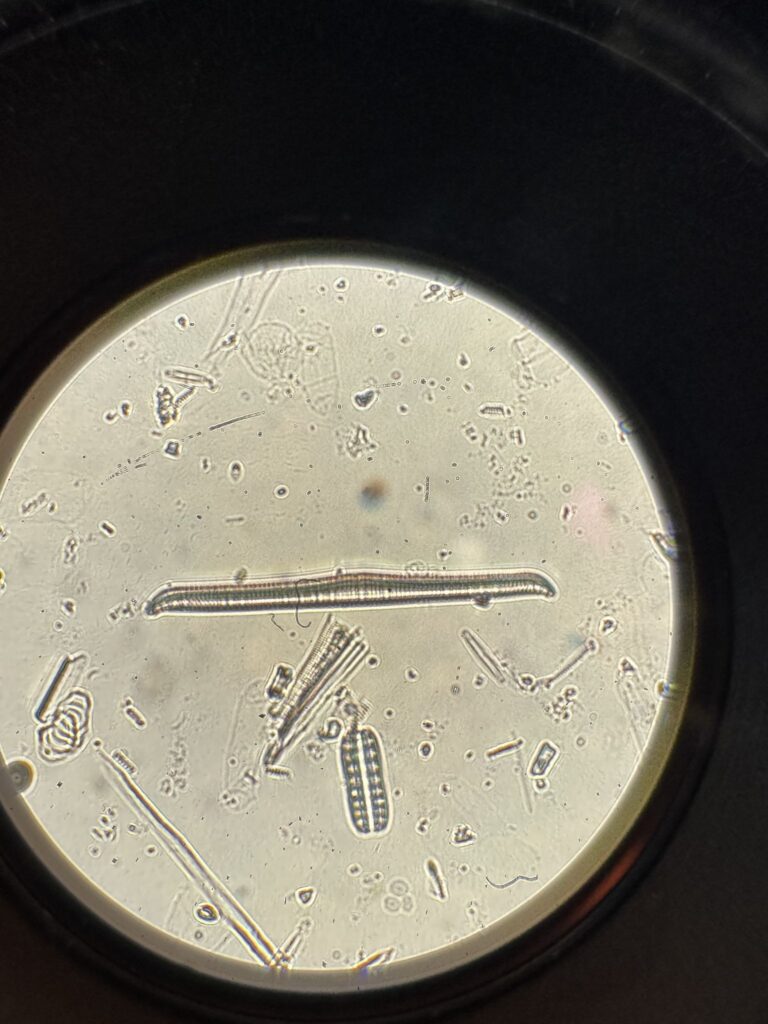
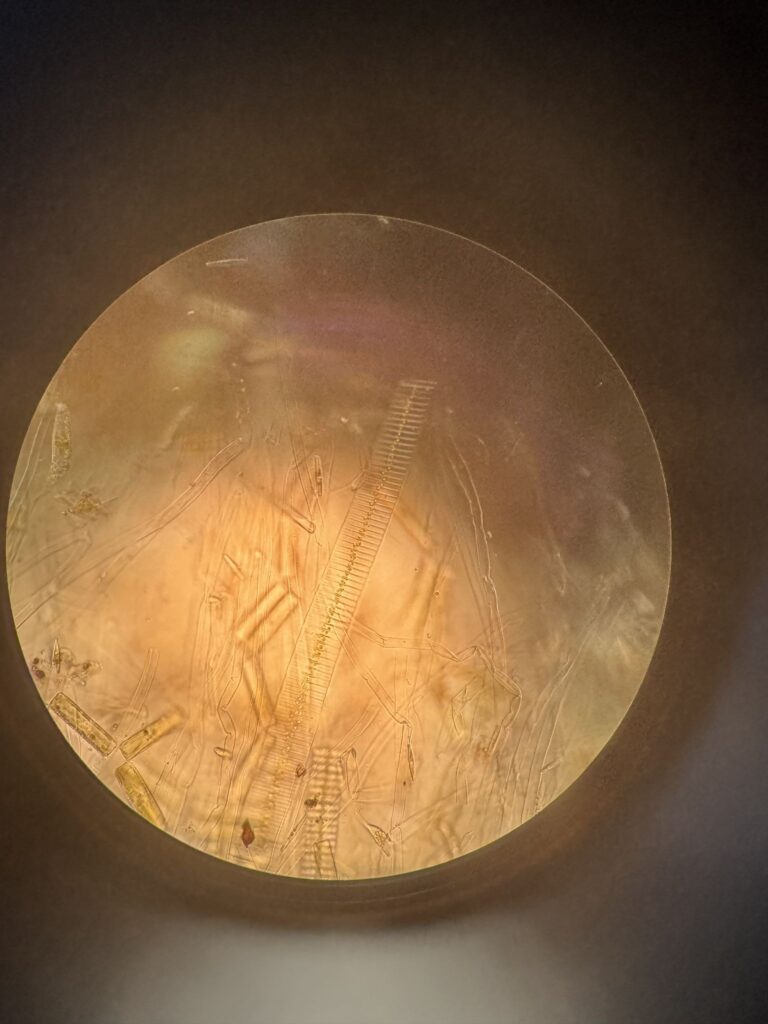
Diatoms build their own houses out of silica. When they die, the houses sink and settle and become the mud scientists here read like a diary — this is what the lake was like a hundred years ago, this is what it ate. Shelter that outlasts whoever built it. I sat with that for a long time.
I wanted to make diatom shapes that were wearable and touchable. A little silica house of the present moment that we can carry with us.
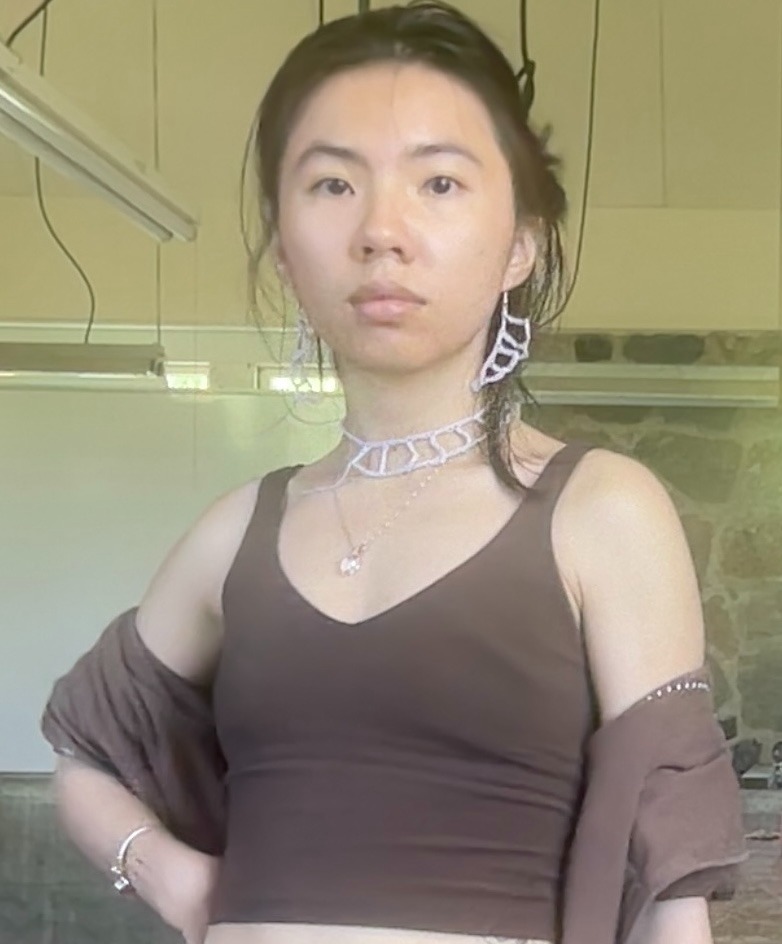
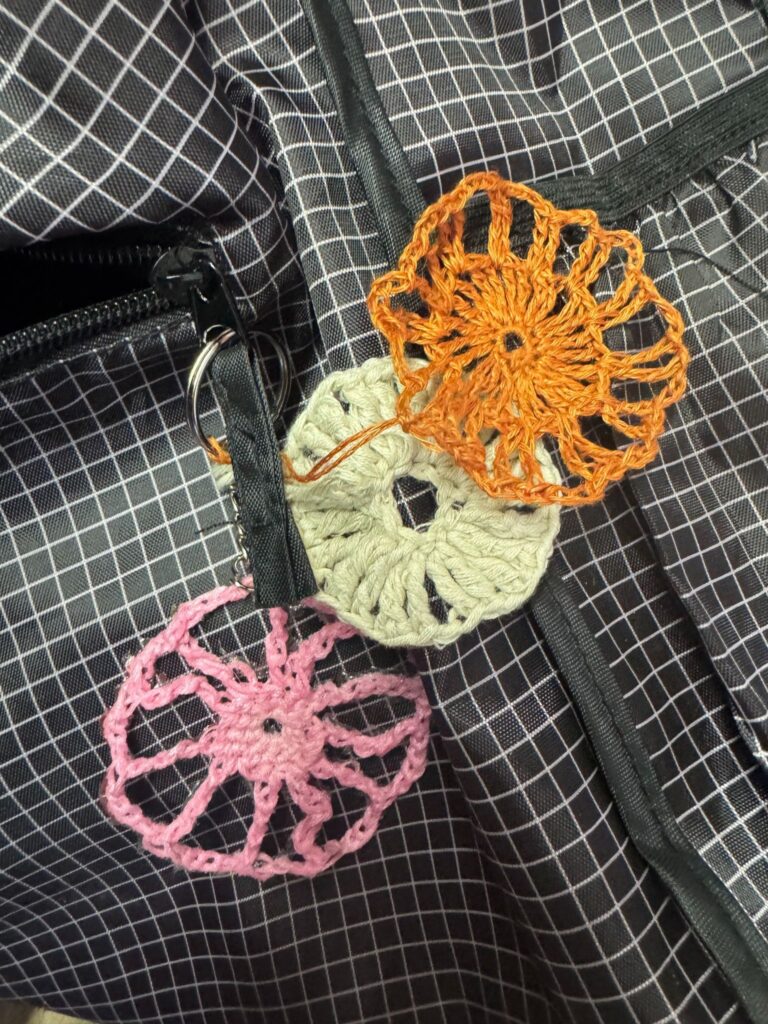
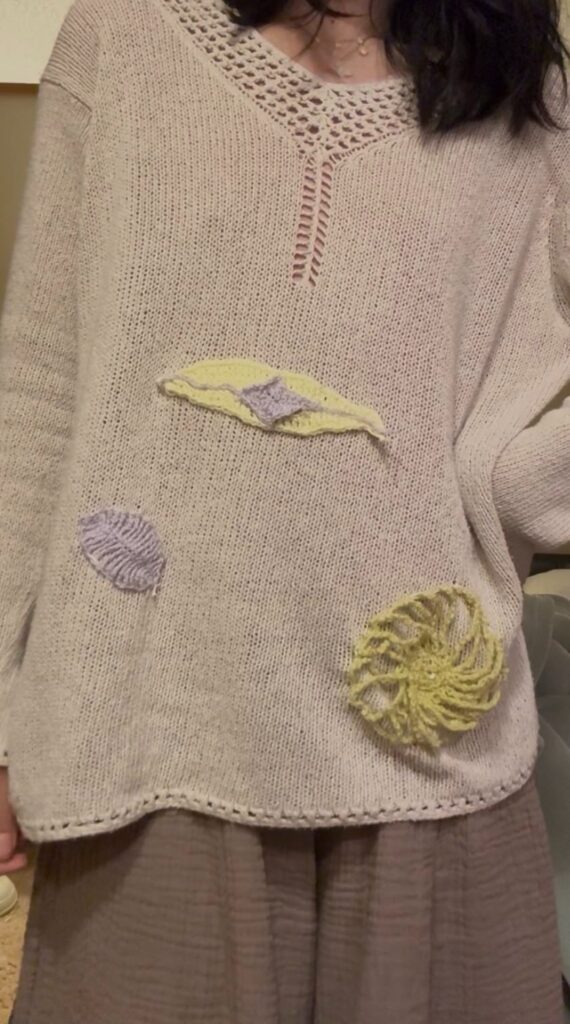
I liked that they ended up on the body. On a zipper, on an ear, on a piece of clothing. LIttle imprint of shelter you can wear.
Diatom crochet and favorite vegetables
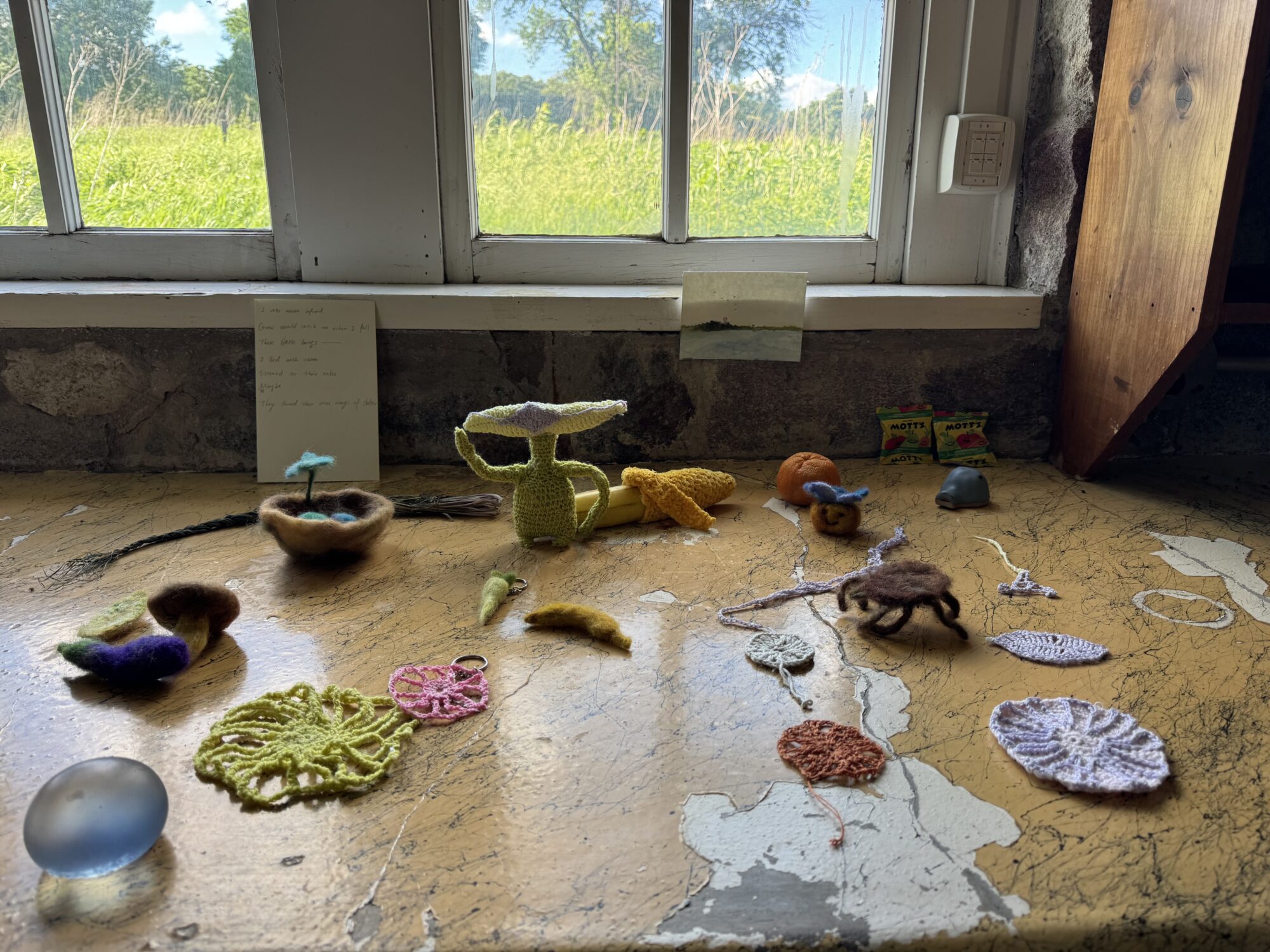
Partway through I organized a small crochet party for the scientists to crochet their favorite diatoms. I also started asking people what their favorite vegetable was, and felting it for them. Everyone answered with such childlike wonder. I realized adults don’t get asked what their favorites are very often.
That’s what the small things are for, I think. They give you back a minute of being small. The child version of me was a fool exploring nature’s wonderland, absolutely unafraid of ticks. She lies down in the grass. She even picks up the bug and talks to it sometimes.
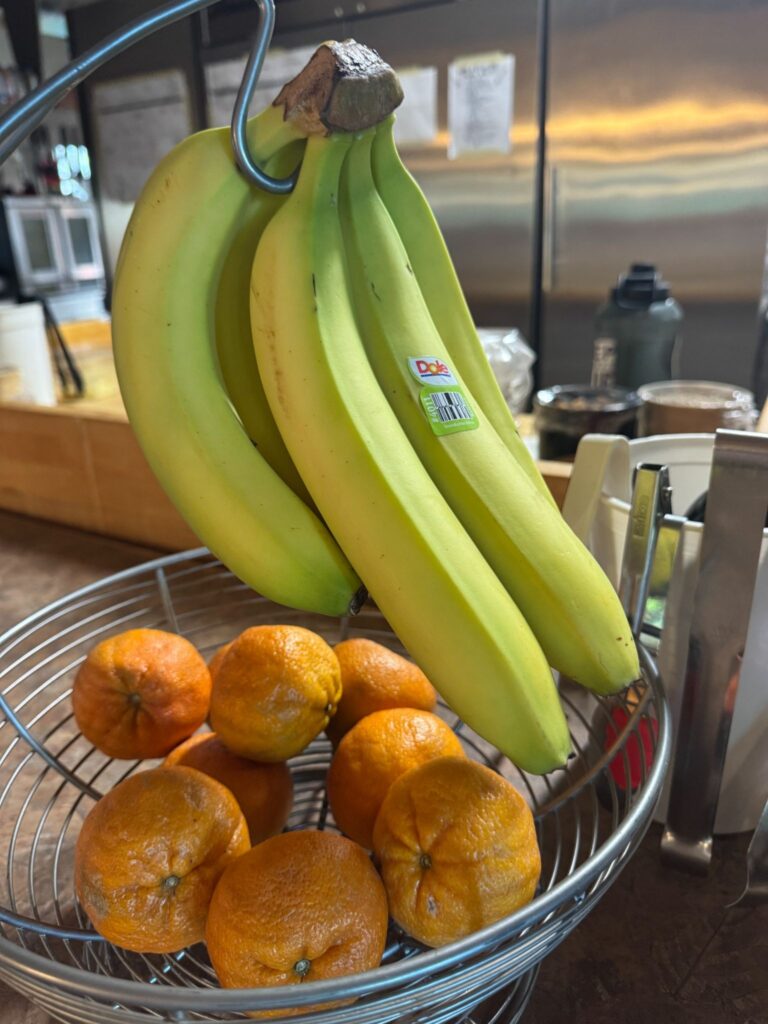
I lost that somewhere in the last year, in the waiting and the arithmetic. There is no version of the world where ticks or borders aren’t scary. But for one stitch, one needle in and out, the fear goes somewhere else, and what’s left is a hand, some wool, and the wish to make a small thing that’s fuzzy and fun. I grabbed a banana from the cafeteria and started felting a bag to hold it. Banana in the United States are always slightly too green, compared to the ones in Southern China where I’m from. But nonetheless, must be nice to have a place that holds you tightly.
Then I hosted a crochet party.
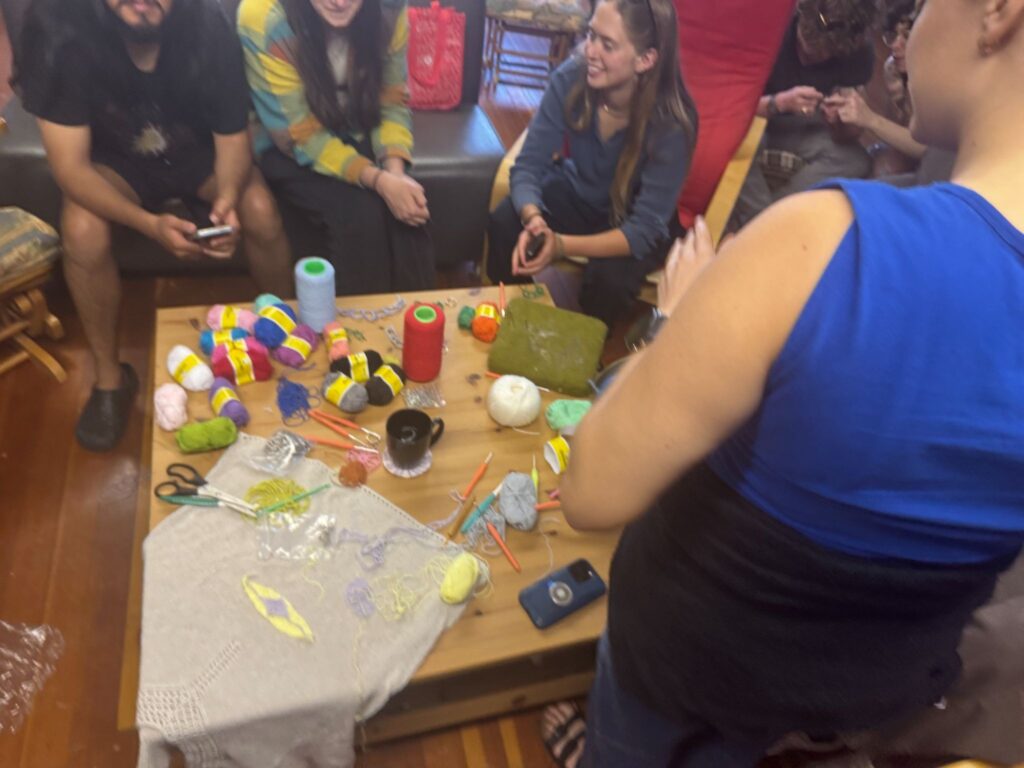
Several people pulled out three rows because they counted wrong or the row weren’t dense enough, we all laughed as we failed together. People made species that don’t exist out of counting accidents. By the end a colony lay across a knitted sweater, and most of it walked out on someone’s keys.
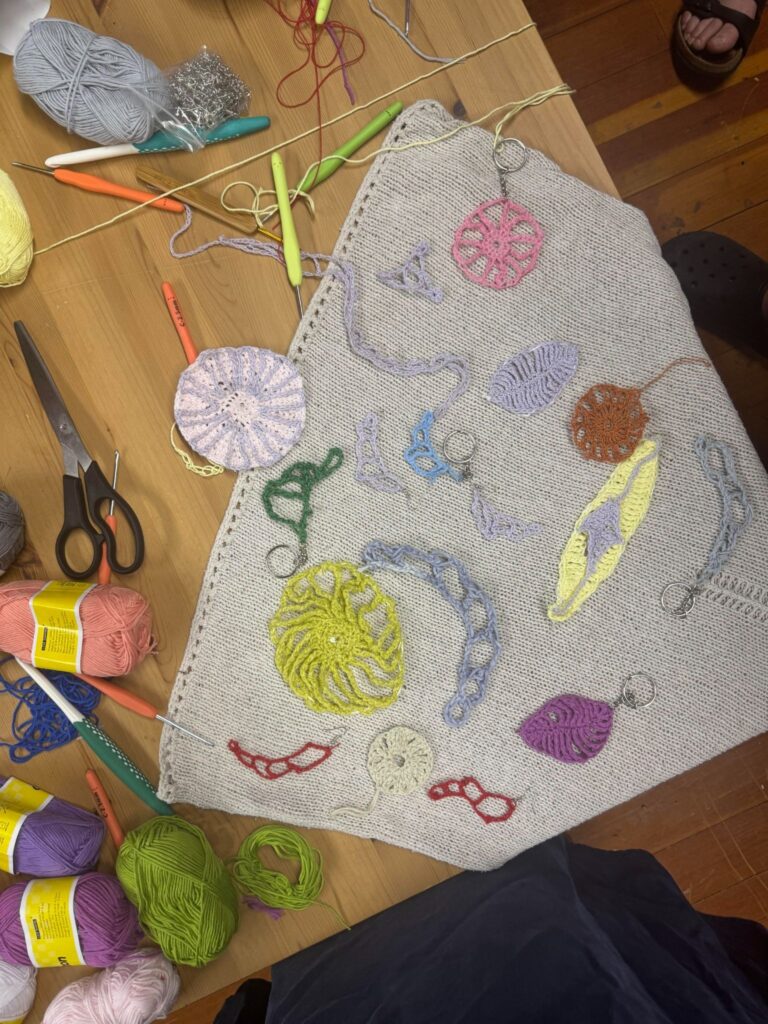
I’d hoped people would learn the magical slip stitch. What I really wanted was for a thread to run between them and something too small to see.
Two diatom researchers stopped by the studio after dinner one night and asked if they could try felting. We sat under the window with the dark coming on and the needles going.
We talked about families. Where we came from, who stayed, who left, what we carried. Three people from three different places, stabbing wool in a stone lab in Iowa, and nobody performing anything. The hands stayed busy so the stories could come out sideways, the way true ones do.
One of them made a carrot and gave it a face. The other made earrings — an eggplant and a carrot — and by the end was asking where to buy needles.
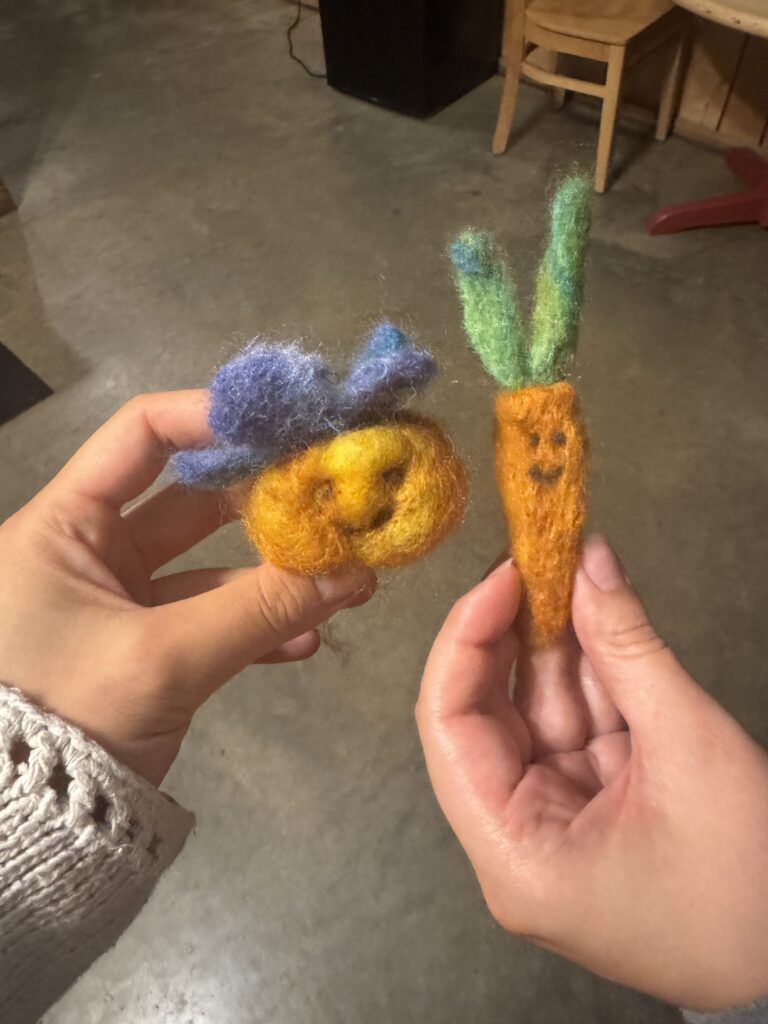
They thanked me afterward. Said it was the most relaxed they’d been in weeks. I didn’t know how to tell them what it had been for me. I had arrived feeling like I belonged nowhere. For one night I belonged at that table — in this small world we made out of felted vegetables.
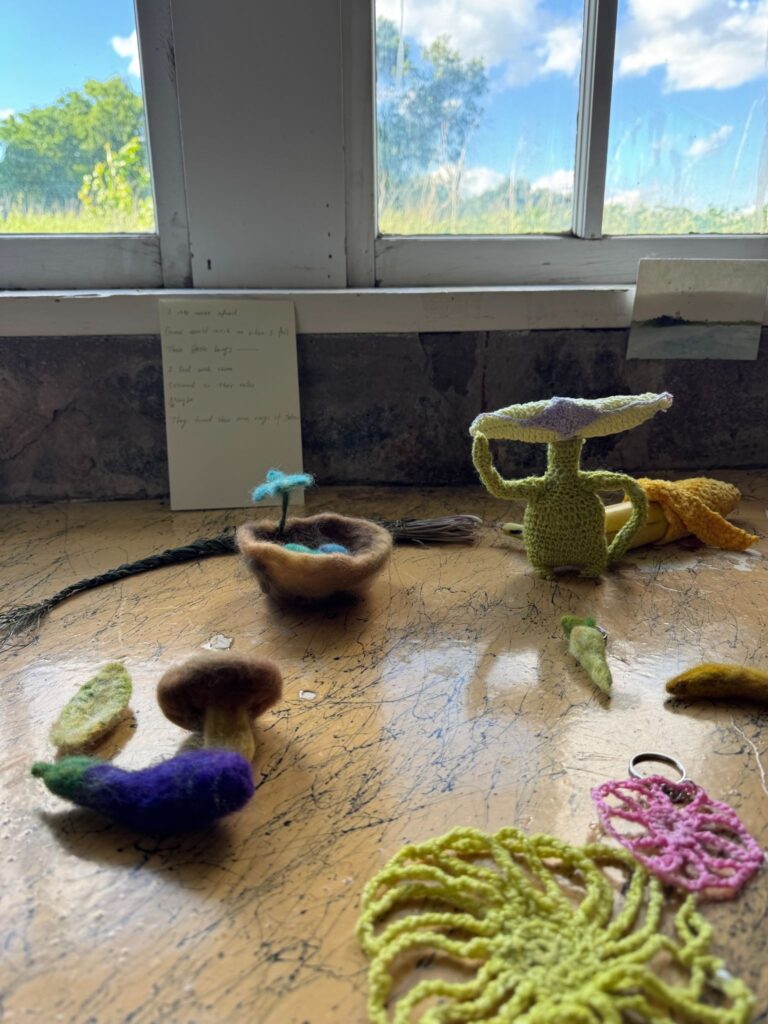
I made a small felted nest with three blue eggs because I missed home.
Journey into the blue oasis
Maya and I took walks. Long ones, along the shore and out through the prairie, and I told her what scared me about going home — the house I’d walk into, the parents I hadn’t seen in years, the two of them now in two places. She told me about the years I’d missed. We caught up the way you can only catch up with someone who knew you before you were any of this. The walks felt magical, and I don’t use that word easily. They felt like a shelter of our own.
One afternoon we took the kayaks out. We’d gone kayaking together once, many years ago, two people who had barely finished being kids. This time we pushed off from Lakeside into the open water and the world got big fast — the lake wide and bright, the shore sliding away, the two of us small on it.
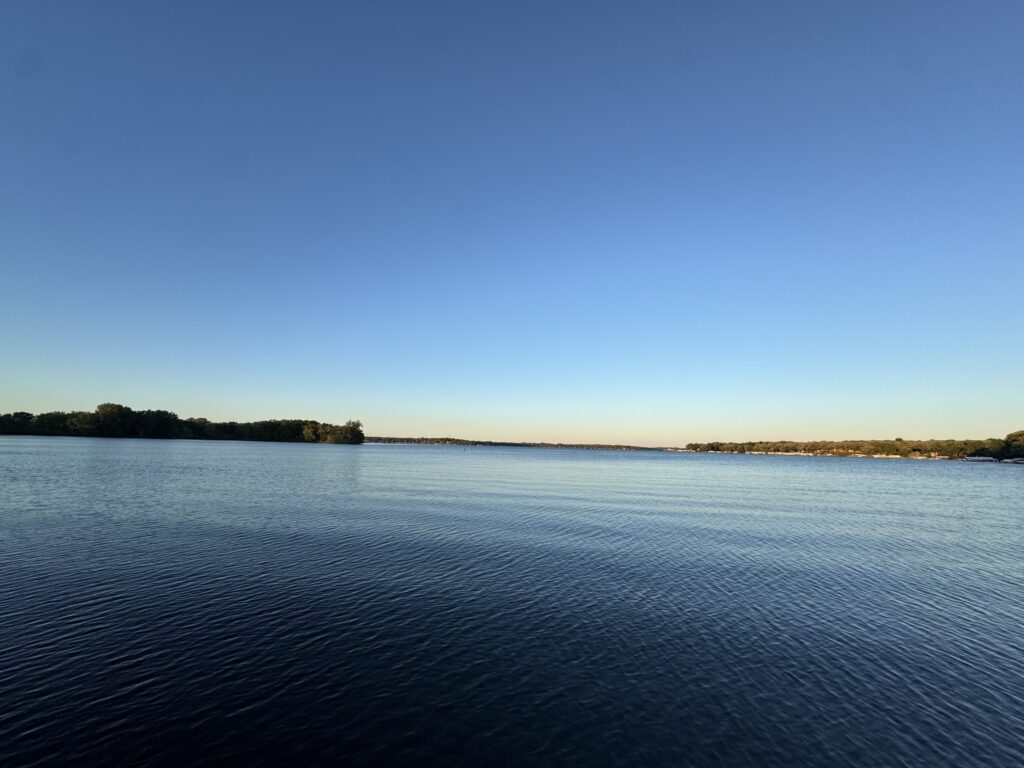
Then we turned into a canal.
The banks came in close. The water went quiet and green. The sky narrowed to a strip above us. It was just us, and a few feet of water, and nothing else. The world had become small again — and in the smallness I found belonging.
But I wouldn’t have known that without the open water first. I wouldn’t have known what this friendship meant without ten years of being out in the world, far apart, and then coming back to share one still afternoon in a narrow channel in Iowa. You have to feel how big it is. Then you can feel how small.
Going Home
On the last day I felted a tick.
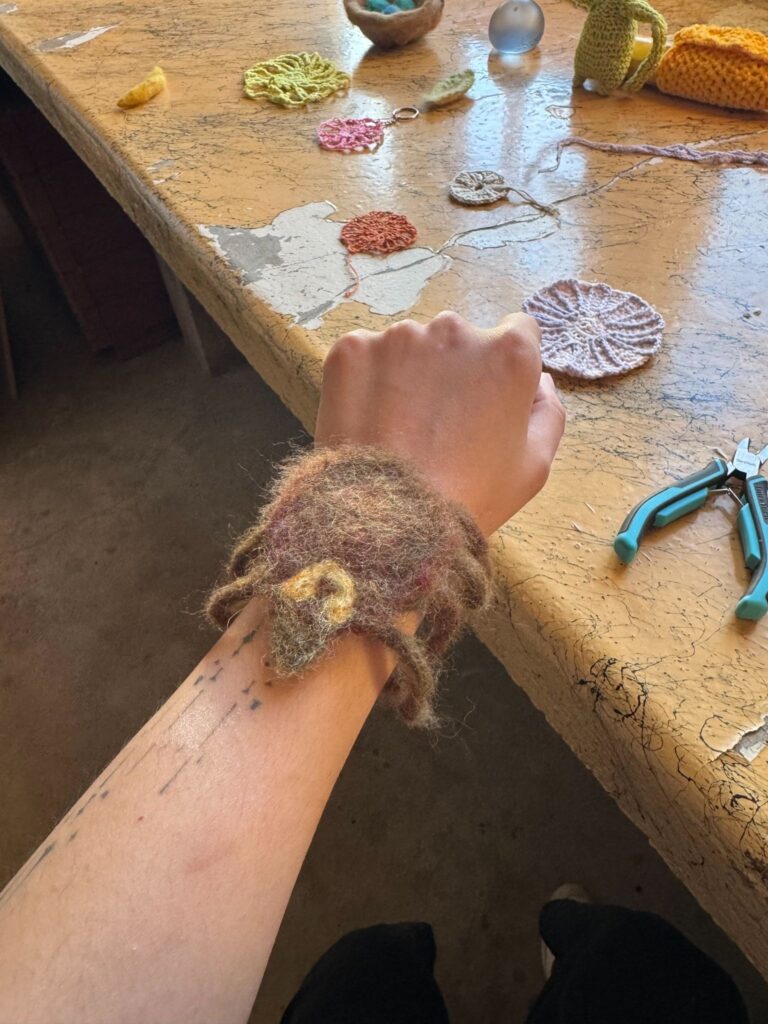
Brown wool, eight legs, a yellow mark on its back, made into a fluffy wristband.
Somewhere in the two weeks the hatred had turned into something else. Someone told me the ticks were invasive — new here, spreading — and the word landed on me the way it was never meant to. I’ve been a version of it, in forms and interviews and comment sections. Non-native. A question.
So where is a tick’s home? It didn’t ask to be carried here. It waits on a blade of grass with its front legs out, hoping something warm walks by, and it has made a life in a place that didn’t invite it.
This is the poem I left in the window:
I was never afraid, grass would catch me when I fall. These little beings — I lied with them, listened to their tales, Maybe, They found their own ways of shelter.
I set up under the window facing the wild prairie. A nest with three eggs and a blue flower. A green figure holding a leaf over itself like a roof. A braid of prairie grass. I didn’t plan for them to be about a strange, displaced homesickness of some sort. Everything I made that week turned out to be about shelter.
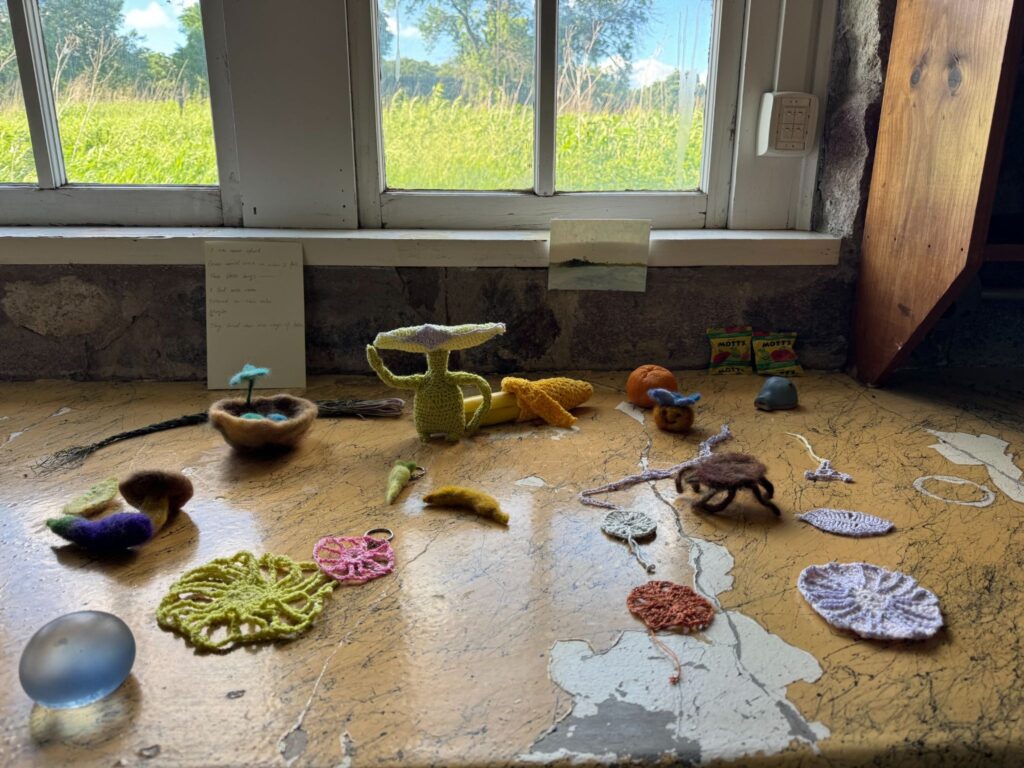
Far and near, big and small. I still don’t know where I’ll be in a year. But I’m leaving with a wristband and a colony of glass houses, and with the small, stubborn idea that shelter is something you make out of whatever is around you — silica, grass, wool, a friendship came together again 5 years later, a small oasis for two.