

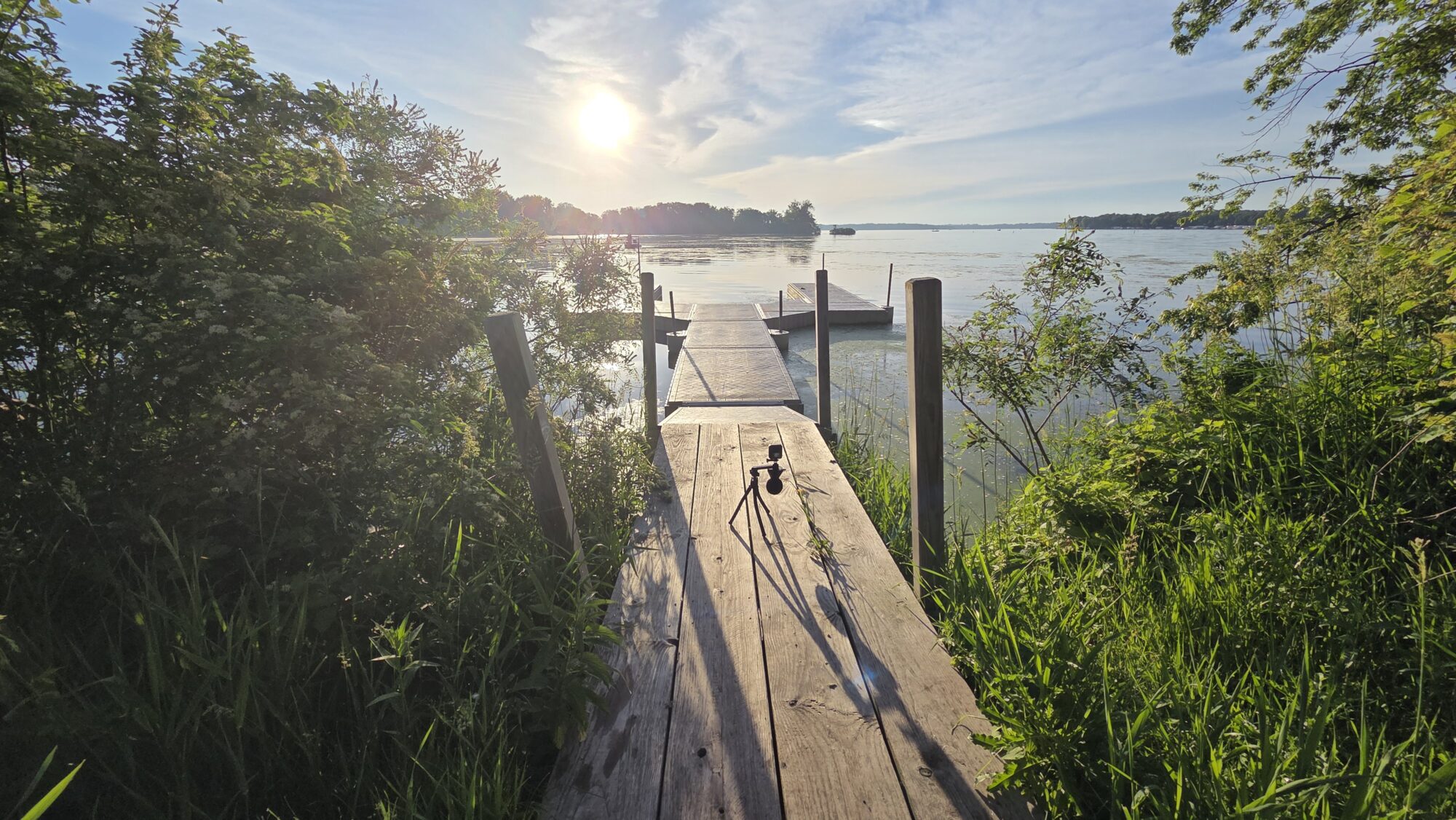
What I brought
The plan was clean. Set up a cube array — four mics at alternating top and bottom corners — and triangulate. Localize sound in three-dimensional space the way you’d localize a structural load. Build something that could eventually inform a spatial algorithm for architectural design, something with swarm logic, something rigorous. I am, after all, trained to think this way. I have spent most of this spring teaching second-year architecture students about thresholds — what they are, how to design them, what a somatic response to a threshold actually feels like in the body. Most of them think “threshold” = “door”. I came to Lakeside Lab already knowing it means more.
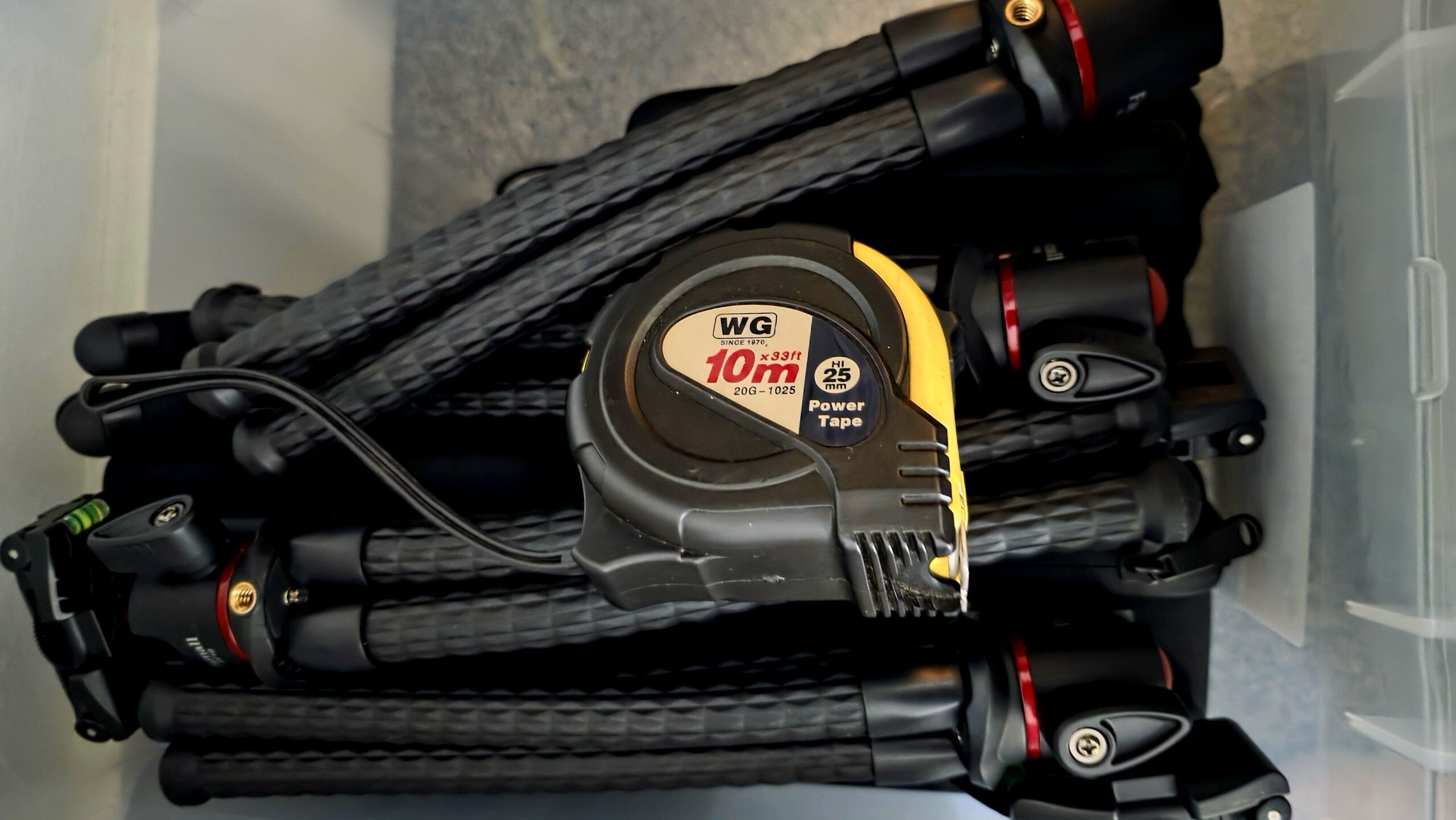
The measuring tape was never used.
The place arrives first
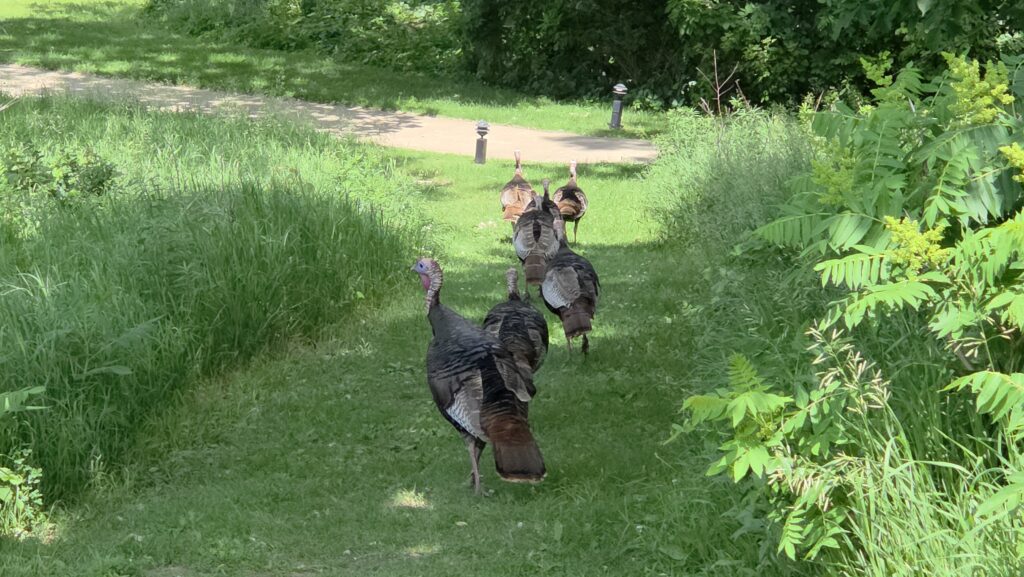
On the first afternoon, a gaggle of wild turkeys claimed the parking lot where I’d left my car. That night, a deer leaped out of the dark on my walk back. By the library, I heard giggling I wasn’t part of. Lakeside Lab made it clear, gently and immediately, that it had a life already in motion, and I was the one arriving into it, not the other way around.
When I arrived, I had the sense that the place might carry something of the Manhattan Project — curious minds, collegiality, brilliant people circling a hard problem together. I was closer to right than I expected, though it felt less like history and more like the SyFy show Eureka, where you can focus on one project or muse together about many ideas around a bigger question: how can we co-exist on this land?
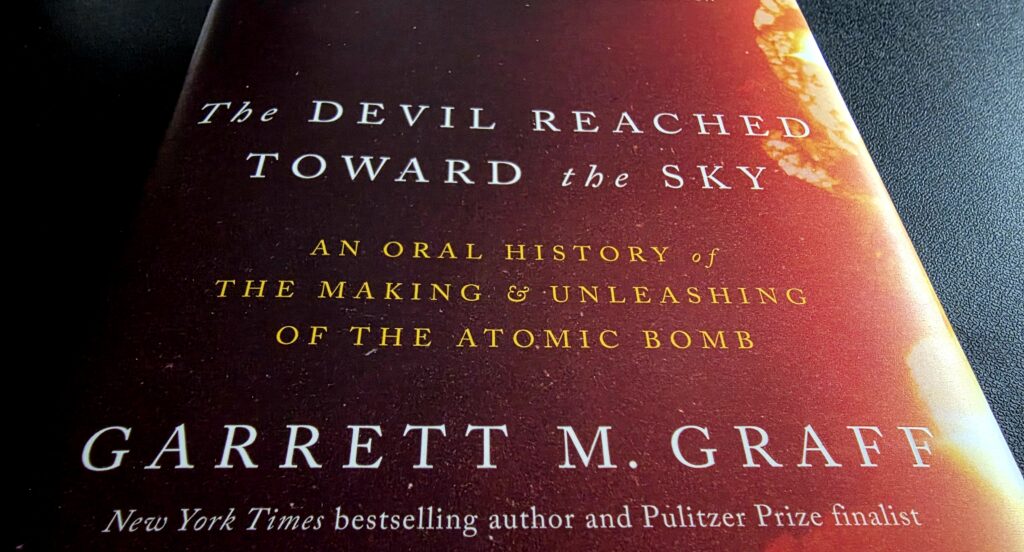
There’s a tradition here: residents host evening activities, whatever they’re moved to share. A year ago, I learned that Ames, Iowa, has its own thread in the history of the Manhattan Project — my friend Brittany Prater (Brit) made a documentary about it, Uranium Derby. When I mentioned this on my first day to the writer-in-residence, Liam Flake, who is also from Ames and was currently writing about it, I lent him a book I had with me, and we organized a screening together. Brit joined by video afterward to take questions and get introduced to this amazing, diverse group of people. That’s the ethos of this place. You notice a connection, and the structure is in place to let you contribute to the collective.
Crossing a threshold
I didn’t realize until I turned around to take stock
Science describes accurately from the outside, poetry describes accurately from the inside.
~ Ursula K. Le Guin
On day two, I joined the kinship creative writing class, taught by Zoe Fay-Stindt, for what I knew could only be three days out of a month-long intensive and immersive curriculum. I went in already aware, as an educator, that a few mornings and afternoons could only be a glimpse.
We talked about echolocation as a practice of finding kin — human and non-human alike. The colonial practices are the opposite of that. I am reminded of those who proclaim to decolonize architecture and pedagogy, rarely practice echolocation, i.e., listen, understand, and create space for nuance. Where Zoe genuinely provided that space, when I was trying to explain how the Nile’s historic irrigation system worked, I used strange phrasing, saying that a ‘piece’ was allocated. It was not a translation; I was just reaching for a word, and that is what I found, and it was accepted. We later discussed how English may not be a suitable language for this kind of writing. For me, images and drawings are my language, and English, although my first language, and Arabic, my mother’s language, are both more foreign to me than these seasoned writers might think. I communicate, ideate, and develop my thoughts with drawings and code.
We read about sacred water, about water in the womb as the first offering of love – I was reminded of John Cage and previous readings that it is also the first sound any of us hear. The class, the space, the process surprised me: I wrote, in my own hand, something I hadn’t planned to write:
Thresholds of water
I would spend summers with my mother in Egypt as a child. My mother, her siblings (6), my grandfather, and grandmother would go to the beach.
The water was always a refuge.
My mother, an ex-water polo player, and her sister, a synchronized swimmer, even though they grew up in a time when women could be on the beach, by the time I was around, Egypt had shifted, and hiding in the Mediterranean, created privacy — a moment to be yourself.
I hated the heat; it was my refuge from the hot sand and the crowds.
The sea would invite us and keep us safe; we would swim all the way out to where the buoys stopped the ships from coming to shore.
Hour by hour, the water kept us afloat; it was effortless to stay in the water.
Even though I had not formally learned how to swim, I have always been comfortable in the water. At the age of 43, after a series of surgeries, I decided to formally enroll in an adult swimming class.
I was not afraid of the water. I was afraid of the side of the pool. I broke many bones, but I knew that once I’m in the water a cannot break.
The water was my protector – from the threatening side of the pool.
I knew if I just can get into the pool I was safe. Swimming leisurely on my back, my preferred form for solitude, silence, and rest.
But the water turned on me…
I was too in a hurry to get better, and in a moment, my arm stopped working…
I am still not sure why that came out there, in that room, on that morning. In allowing myself to immerse in that experience, I found a gift — a revelation: that my name has a strong connection to the water, the Nile; Merate ميريت is the goddess of prosperity, a name bestowed on the Nile’s bride as an offering to ensure a plentiful flood for the year ahead.
The moment did not feel like a detour from my research. It felt like the actual subject was arriving.
@ The Threshold of Water
Led by Tylor, from the conservation corps, we pulled garlic mustard from the ground that same week — an invasive species, hands in the dirt, no recording equipment in sight. I came here to record. I wrote that night, but the field is already listening back. We spoke more about language. Tylor, like me, is a more scientific person who thinks in that language, who harbors no animosity toward the garlic mustard we spent all morning trying to extract, but speaks with great love about one specific tree. The discussion revolved around how specific words that in a scientific context are not only benign but celebrated, only to realize that in a different context they are hurtful – it is not the word’s fault that people use it to harm others.
Although I wish I had recorded all this as my memory slips away, I remember the patch, the intimacy of pulling each root, the tree we sat under to discuss the readings, and the indelible scar on my back from finding a tick an hour later. The grounds were listening.
That sentence became the question that organized everything after it:
Who is recording whom?
The fen, the tree, the tears in the ground
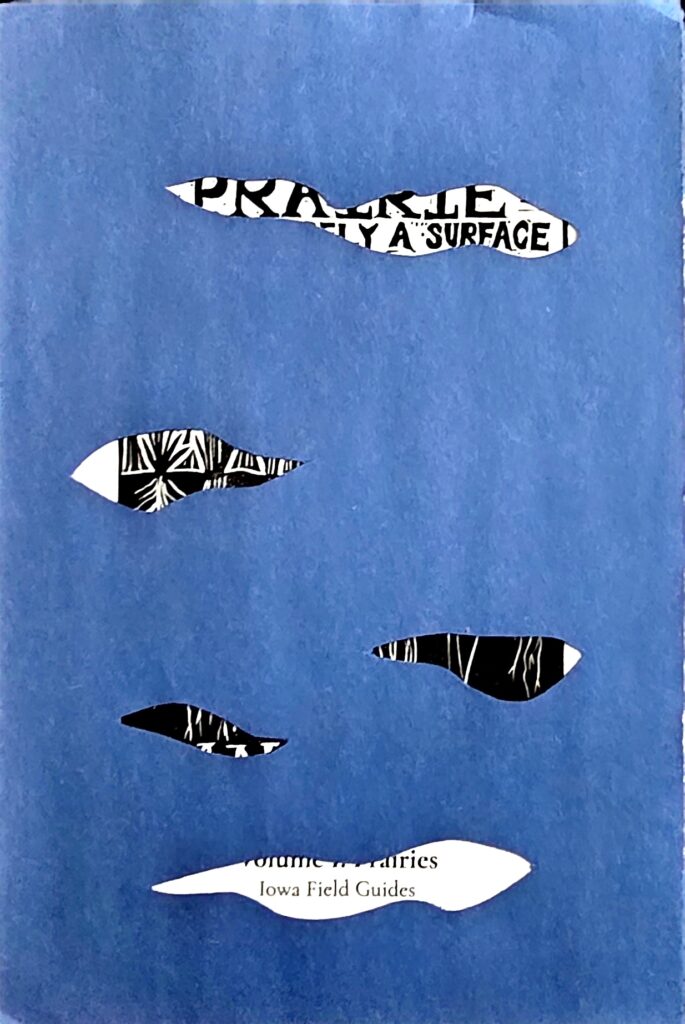
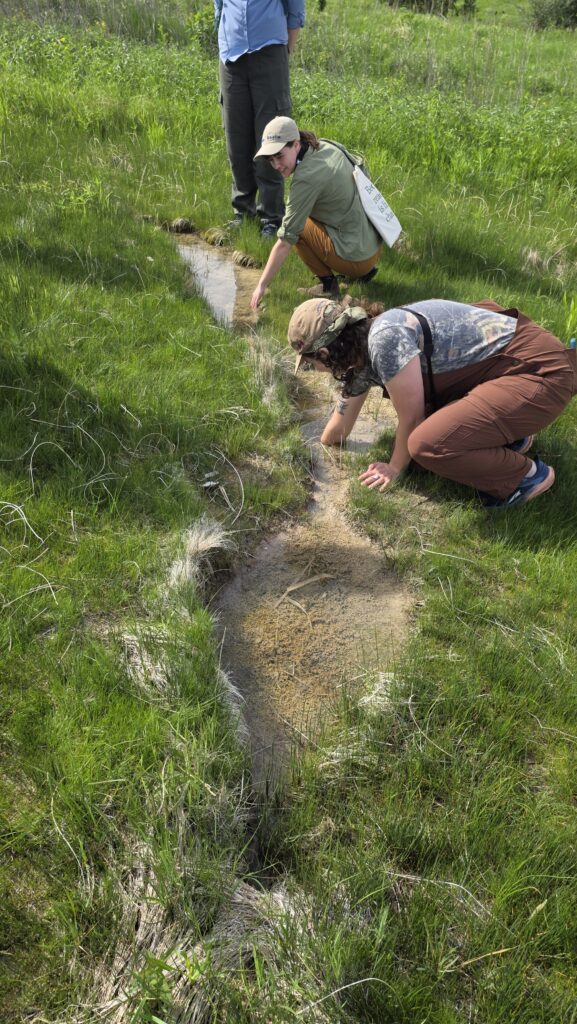
On day four, we drove to Silver Lake Fen with Claire Jussel and Amie Adams, who, the day before, led a community event with readings from their publication Iowa Field Guides Volume I: Prairies, for a guided writing session in the field. A fen is a particular kind of threshold — not quite water, not quite land, saturated ground that holds both at once. There are flarks there, the local name for the long pools that form between raised ridges of peat. Amie and Claire described them as bottomless because they are, in fact, a continuous opening down to the water table. To me, I could see how the gravitational pulls created rifts, like tears in the ground, fissures shaped by the weight of patches of peat and the persistence of water moving where it wants to go. It was a beautiful system in perfect equilibrium, and our presence may tip the scale – respect was owed or else…
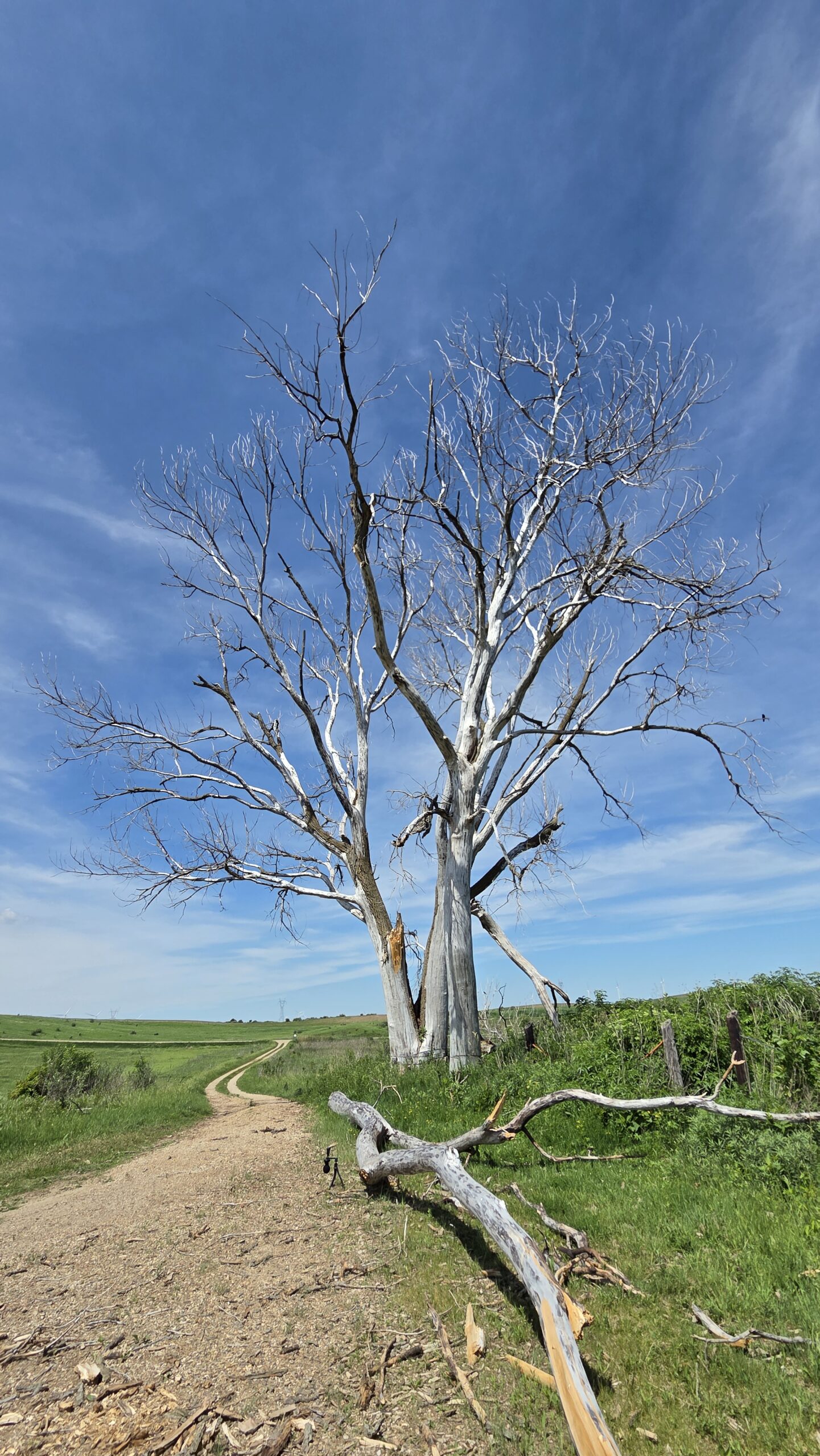
There is a tree at the gate of the fen, bare and bleached, two trunks rising from almost the same root. The first time I visited, she was singing — resonating audibly with the wind, a sound like a warning call from a matriarch, a general, a protector. I tried to record at her gate because she belonged to the thread that was already forming: she was a threshold of water. But her song eluded my equipment, masked by the wind. The matriarch’s sentinels — red-winged blackbirds stood in the ready, perched at the very top of the grass in what I started calling their hi-vis jackets, watching, swooping in sine-wave formations to cover the gaps in their territory.
Amie and Claire must have mystical powers. They offered simple prompts, some where fast paced – almost like fire round questions. Somehow, their methodology is a brilliant jostling of the subconscious. I wrote a piece, and when I stopped, I couldn’t help but say out loud, “How did you do that?”
I wrote prose!

@ Silver Lake Fen
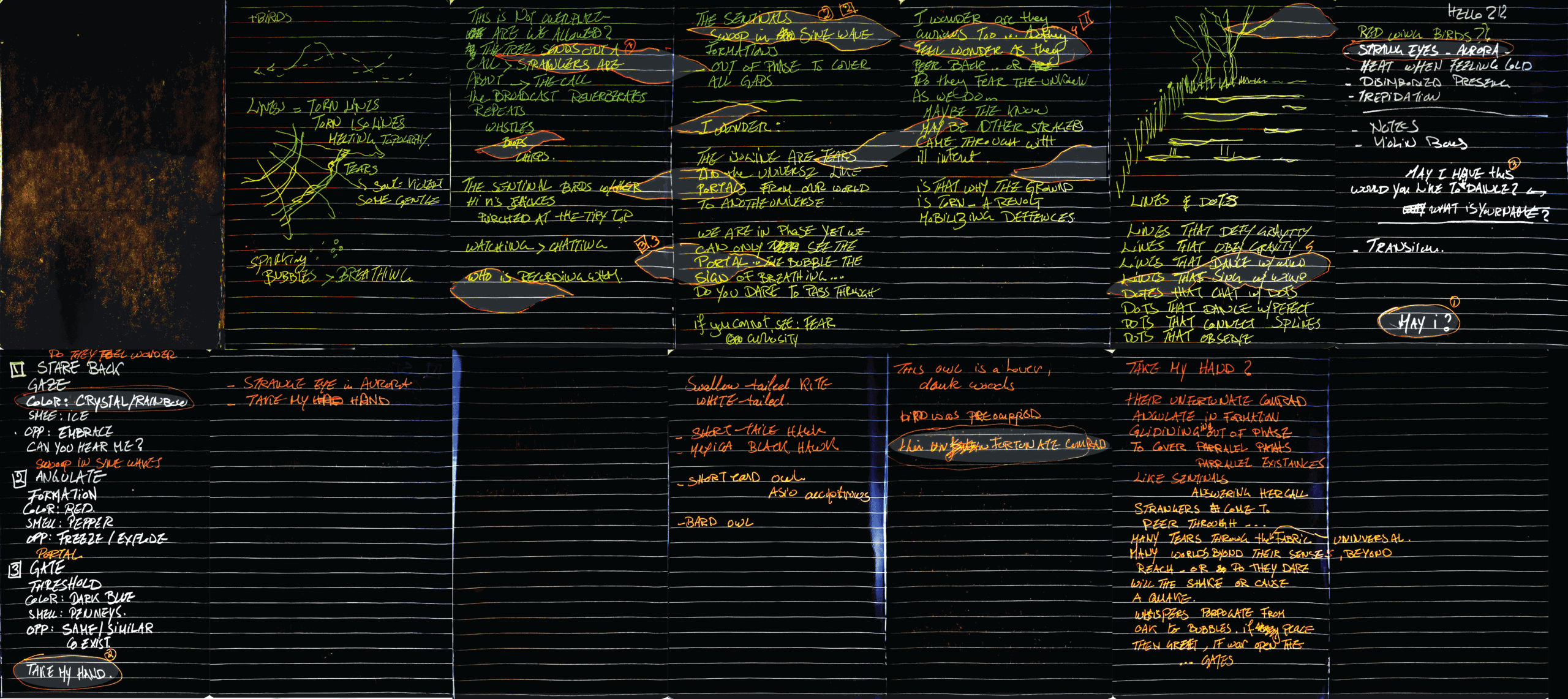
I Notice…
BIRDS
LINES = TORN LINES
TORN ISOLINES
MELTING TOPOGRAPHY
TEARS
SOME VIOLENT
SOME GENTLE
SPARKING
BUBBLES -> BREATHING
THIS IS NOT OUR PLACE
ARE WE ALLOWED?
THE TREE SENDS OUT A
CALL -> STRANGERS ARE
ABOUT -> THE CALL
THE BROADCAST REVERBERATES
REPEATS
WHISTLES
BOOPS
CHIRPS.
THE SENTINEL BIRDS W/ THEIR HI VIS JACKETS
PERCHED AT THE TIPPY TOP
WATCHING > CHATTING
WHO IS RECORDING WHOM?
THE SENTINELS
SWOOP IN AND SINE WAVE [2]
FORMATIONS
OUT OF PHASE TO COVER ALL GAPS
I Wonder…
THE ISOLINES ARE TEARS IN THE UNIVERSE
LIKE PORTALS FROM OUR WORLD
TO ANOTHER UNIVERSE
WE ARE IN PHASE,
YET WE CAN ONLY SEE THE PORTAL …
THE BUBBLES THE [3] SIGN OF BREATHING…
DO YOU DARE TO PASS THROUGH
IF YOU CANNOT SEE:
FEAR
CURIOSITY
I wonder: are they curious too…
do they feel wonder as they peer back… [1]
Or do they fear the unknown as we do…
Maybe they know
Maybe other strangers came through with ill intent.
Is that why the ground is torn – a revolt mobilizing defenses.
LINES & DOTS
LINES THAT DEFY GRAVITY
LINES THAT OBEY GRAVITY
LINES THAT DANCE W/ WIND
LINES THAT SING W/ WIND
LINES THAT CHAT W/ DOTS
DOTS THAT DANCE W/ PERFECT SPLINES
DOTS THAT CONNECT
DOTS THAT OBSERVE
@ The Library
[1] do they feel wonder as they peer back…
STARE BACK
GAZE
COLOR: CRYSTAL/RAINBOW
SMELL: ICE
OPP: EMBRACE
CAN YOU HEAR ME?
HELLO?!?
STRANGE EYES – AURORA
HEAT WHEN FEELING COLD
DISAPPEAR PRESENCE
TREPIDATION
[2] SWOOP IN AND SINE WAVE
ANGULATE
FORMATION
COLOR: RED
SMELL: PEPPER
OPP: FREEZE / EXPLODE
NOTES
Violin Bows
MAY I HAVE THIS
WOULD YOU LIKE TO DANCE?
WHAT IS YOUR NAME?
[3] PORTAL …
GATE
THRESHOLD
COLOR: DARK BLUE
SMELL: PENNIES
OPP: SAME / SIMILAR
COEXIST
TAKE MY HAND.
TRANSITION.
MAY I?
Swallow-tailed kite
WHITE tailed
– SHORT TAIL HAWK
– MEXICAN BLACK HAWK
– SHORT EARED OWL
– BARD OWL
THIS OWL is a lover,
dark woods
BIRD was preoccupied
Their unfortunate comrade
Take my hand?
THEIR UNFORTUNATE COMRADE
ANGULATE IN FORMATION
GLIDING IN AND OUT OF PHASE
TO COVER PARALLEL PLANES
PARALLEL EXISTENCES
LIKE SENTINELS
ANSWERING HER CALL
STRANGERS COME TO PEER THROUGH…
MANY TEARS THROUGH THE UNIVERSAL FABRIC.
MANY WORLDS BEYOND THEIR SENSES,
BEYOND REACH
_OR DO THEY DARE
WILL THE SHAKE? OR CAUSE A QUAKE?
WHISPERS PROPAGATE FROM
OAK TO BUBBLES
IF PEACE
THEN GREAT, IF WAR..
OPEN THE GATES!
It was a magical session. I went back to the fen for a second time to visit, but she was silent, and the sentinels were relaxed, chatting instead. Although it was different I found my recording…
15 species were identified in this recording using the Merlin Bird ID app.
Most prominent:
Red-winged Blackbird (Agelaius phoeniceus)
Northern Yellow Warbler (Setophaga aestiva)
Common Yellowthroat (Geothlypis trichas)
Mourning Dove (Zenaida macroura)
American Robin (Turdus migratorius)
Also present:
Northern House Wren (Troglodytes aedon)
Common Grackle (Quiscalus quiscula)
Brown-headed Cowbird (Molothrus ater)
Tree Swallow (Tachycineta bicolor)
Killdeer (Charadrius vociferus)
Yellow-throated Warbler (Setophaga dominica)
Ring-necked Pheasant (Phasianus colchicus)
Yellow-headed Blackbird (Xanthocephalus xanthocephalus)
Willow Flycatcher (Empidonax traillii)
Eastern Kingbird (Tyrannus tyrannus)
The work finds its own shoreline
Of the Dock, on the shoreline, swimming with the algae was not disgusting; it was strangely a sintering moment with Okoboji. My hair that had been bothering me for weeks now was finally cooperating, my curls tangled with the bits. I had to honor the algae that welcomed me for my first swim.
Trying to absorb Lakeside Lab and all its magic, I would sit in the studio attempting to calibrate my process and rediscover my methodology. It was quite disorienting.
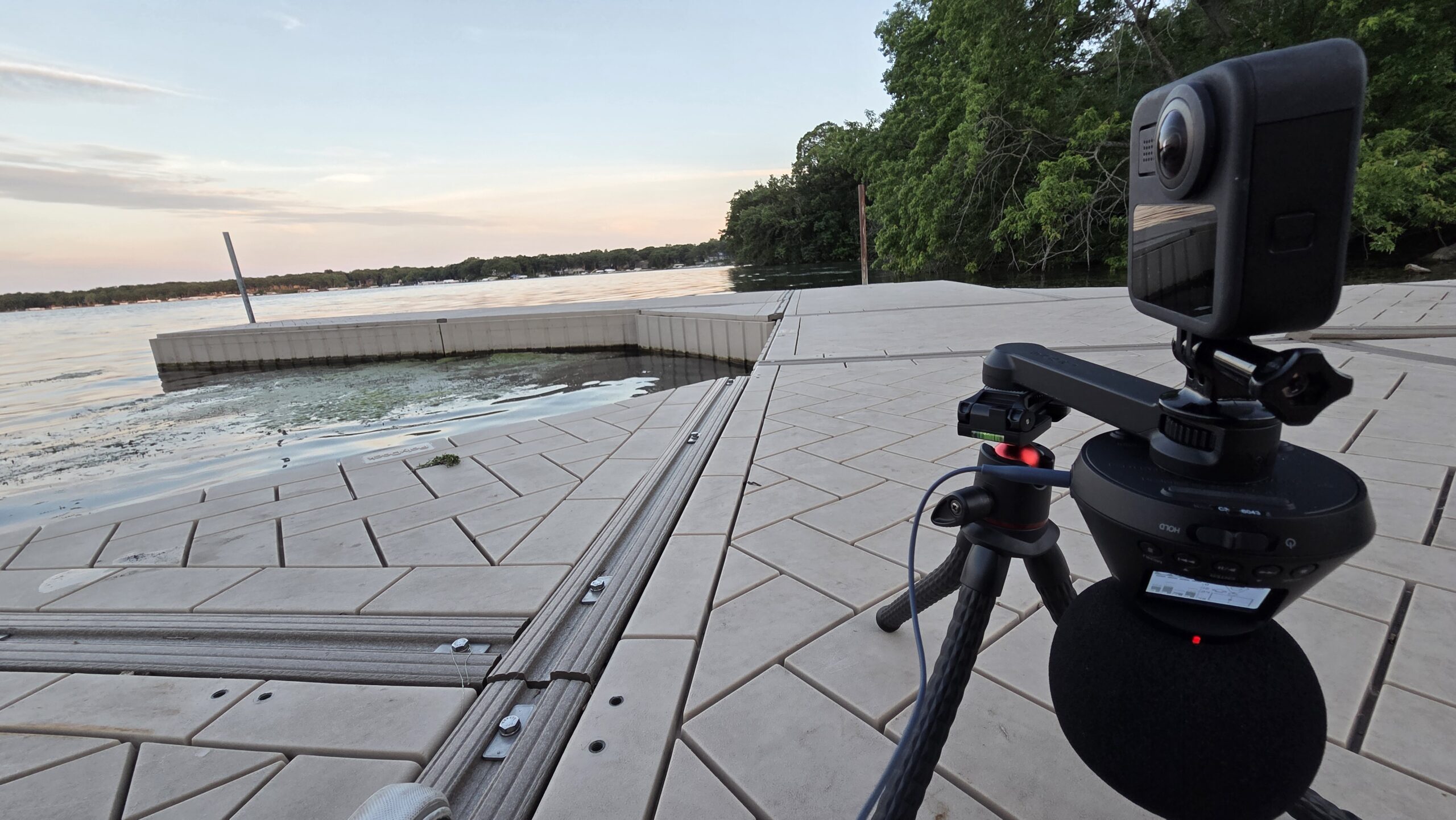
Attempting to find a familiar thread to pull on while understanding that the technical work shifted with everything else. I had brought a 4-channel AmbiX ambisonic microphone, and after some equipment troubleshooting — the kind that eats a full day and teaches you more than the recording itself — I had many files from one Microphone and a GoPro; I had many recordings, none that would help except for three: one outside the studio, one on the shore, and one from the fen.
The fen, the sentinels, and the tree that I fell in love with were my touchstone. I started building a generative visualization in Processing: a field of 40,000 particles responding to the spatial sound data, drifting on Perlin noise tuned to the same fractal exponent — the 1/f structure — that characterizes natural soundscapes. The math and the listening were, for the first time in my work, the same gesture.
The solution, though, eluded me for half a day, circles, ellipses, it just was blaa… After another nighttime recording, whether it was the bats at night or the birds in the morning, it occurred to me, Wait! I know this. Swarm behavior. I just needed to adjust the forces because algae are propelled by water currents, and any disturbance in the water would temporarily derail their trajectory, only to be carried back by the currents.
Building small swarm particle agents drifting toward the shore that would move closer together to create bigger and greener pads. An emergent behavior! But wait, the agents wouldn’t accumulate at the shore, at the bottom of the screen; they kept stalling a good distance short, just sitting there. All morning, I fought what looked like a bug — I tried to fix it. I tuned forces, adjusted thresholds, and second-guessed the physics.
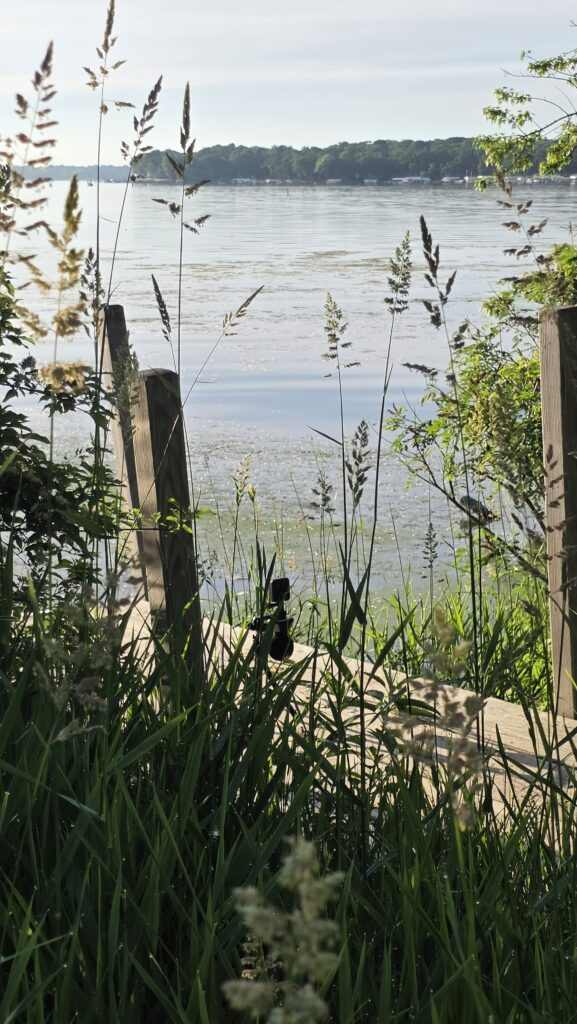

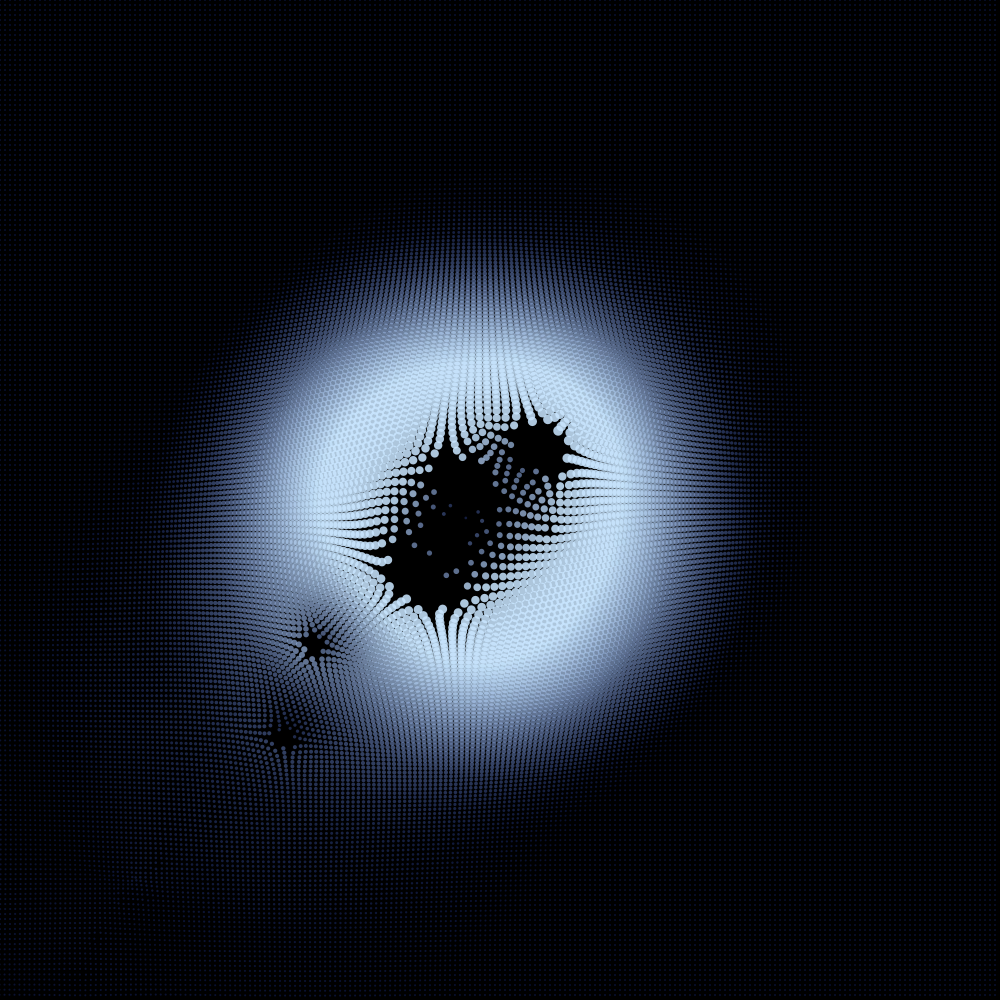
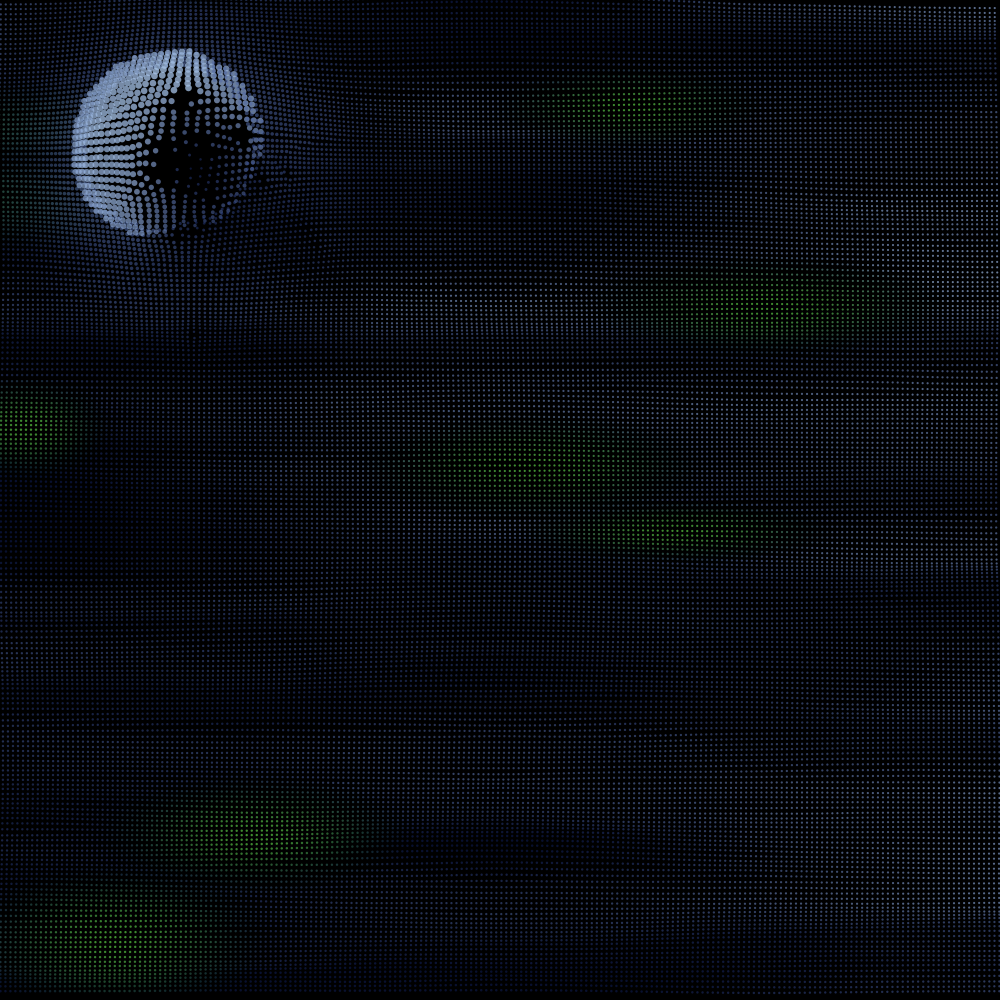
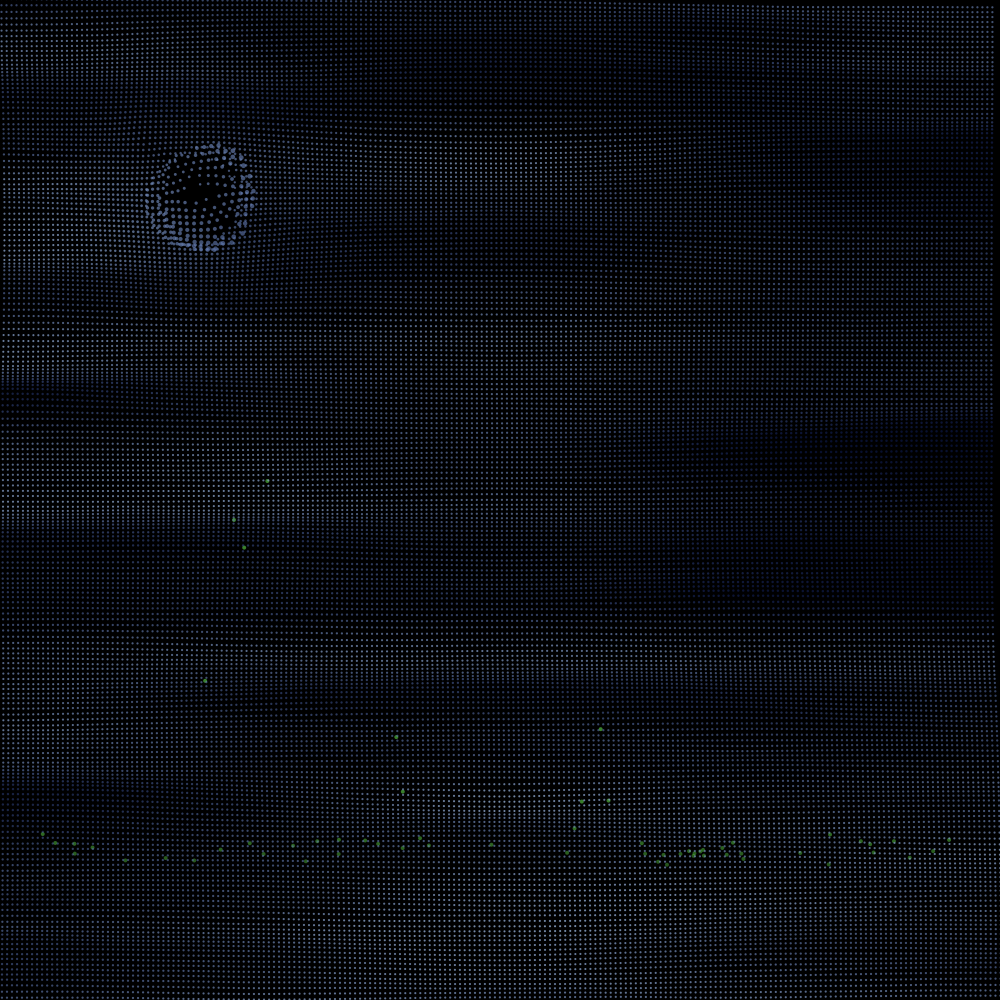
I finally gave up and went to lunch to get some social nourishment. At lunch, staring out at the actual lake, I watched real algae do exactly that — stop well short of the actual shoreline and accumulate there, slowly, the way mine were already doing. My math was correct the whole time!
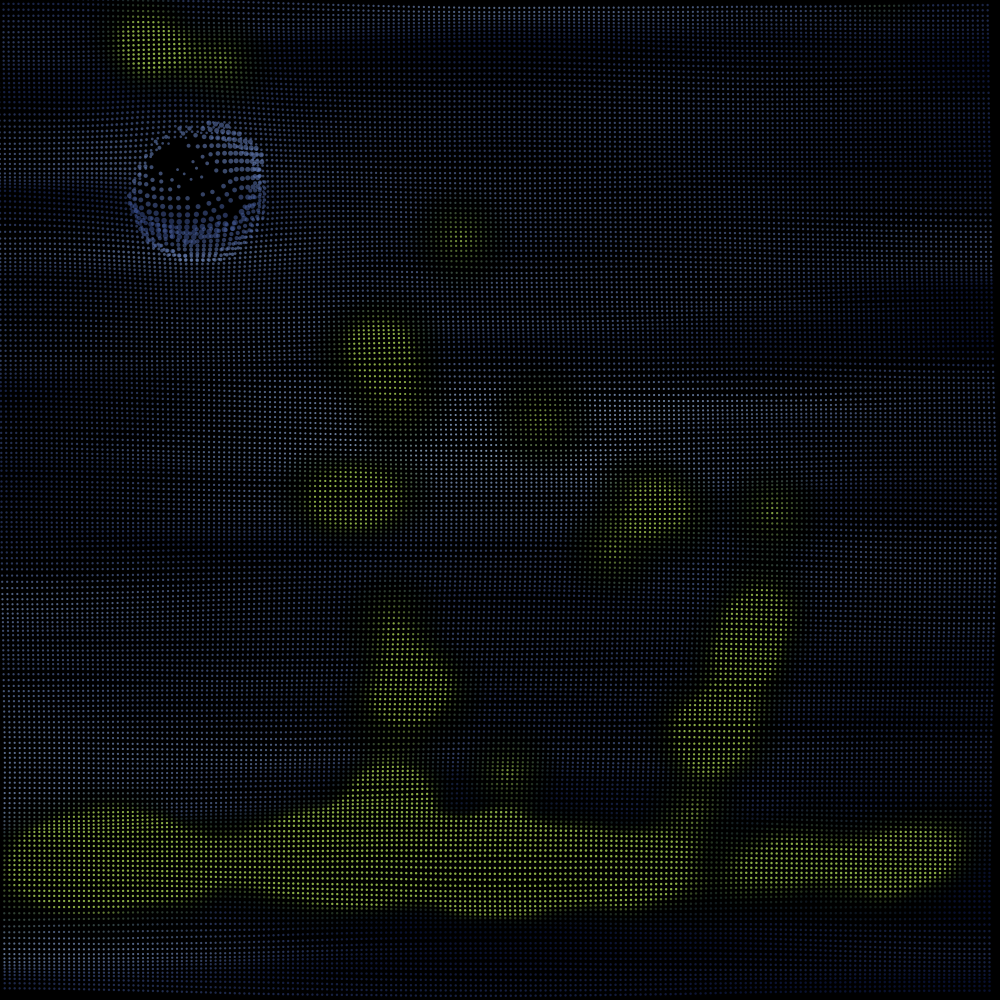
Emergence had simply found its own equilibrium, the way it does, whether or not I had asked it to.
What the others taught me
The most generative hours of these two weeks happened on the dock.
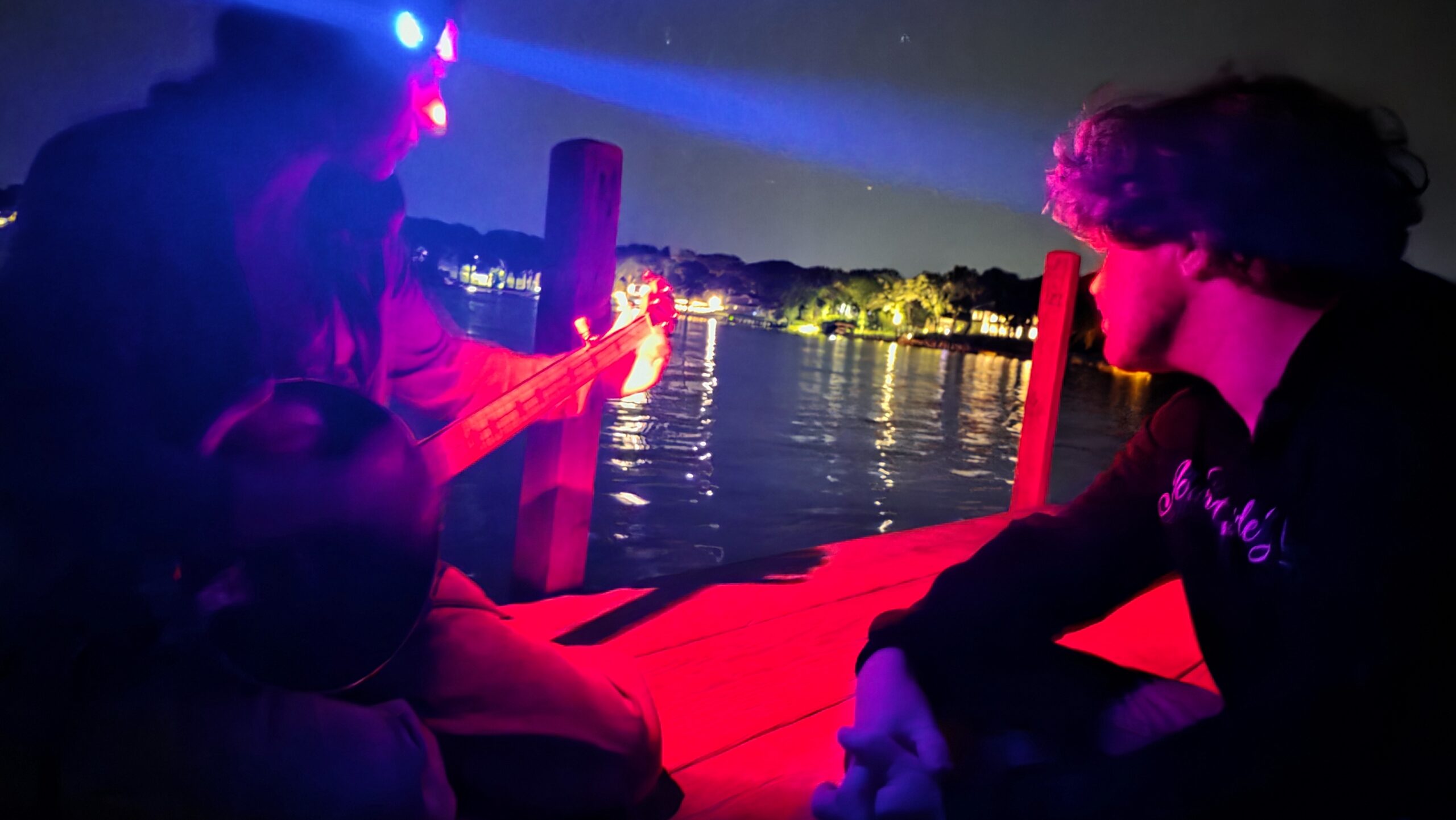
One night, after celebrating a fellow artist-in-resident, Maya’s, departure, several of us ended up out there past dark — at the threshold between the lit shore and the unlit lake, no light except scattered points across the water and the stars and satellites passing overhead. While Okoboji slumbered, Maya taught Liam a rendition of “Who will rock the cradle when you’re gone” on the banjo. We danced a little. Fish rose to take insects off the surface tension. Bats swooped low. It was a different register of the same threshold I’d been circling all week. I didn’t have my equipment, but my phone did a good job.
Earlier that same day, Liam led a writing workshop where we each had to find a being in the landscape and meet it with our senses. I found a mushroom thriving in the shade at the lake’s edge — one organism that appeared, structurally, as many.

ON THE EDGE OF THE WATER
MUSHROOMS THRIVE in MOISTURE — in THE SHADE
THEY – IS ONE
ONE ORGANISM
ONE EXISTENCE
BUT NOT ONE
BUT FOR ANYONE ELSE
THEY ARE MORE THAN ONE
I WONDER HOW IT FEELS TO BE SEEN THROUGH THE EYES OF MANY
THEY ARE NOT ONE
TO GLOW AMONG THE GREEN
TO ATTRACT THE MANY
TO LOSE SOME BECAUSE ONE STEPPED ON IT
TO LOSE SOME BECAUSE ONE CONSUMED IT.
LIVING A LIFE ONLY TO BLOOM & EXPLODE INTO MANY
ON THE THRESHOLD OF WATER IS WHERE IT THRIVES.
THE GROUND GIVES UNDER MY BOOTS
@ THE BOTTOM OF THE CLIFF, THE WATER IS STILL
I CAN HEAR IT ALL
— BUT I AM ONE
ONE OF MANY —
HERE IS A SPECIAL PLACE
WHERE MANY ARE ONE
GILLS
SPORES
EXERCISE CAUTION
PIGMENTED
IVORY*
NETWORK*
SOLITARY* -> SCATTERED
SING
ECCENTRIC*
BRUISING
HIDDEN IN THE GRASS
BITTER TASTE
CLUBS
SCHIZOPHYLLUM
LEATHERY
LONGITUDINALLY
WHEN I COME HOME HE’S WAITING,
HE KNOWS MY ROUTINE.
LAPTOP BAG OFF BY THE DESK –
GROCERIES IN THE KITCHEN –
FRIDGE OPENS TREAT IN HAND.
AROUND TO THE ROOM.
LIKE A WIDE CIRCLE
HE WATCHES,
HE LISTENS
KNOWING THAT MY DESTINATION IS TO HIM
I SIT.
SHOES OFF
TREAT IN HAND.
WE SIT
BACK TO BACK.
IF I TAKE TOO LONG HE TURNS AROUND TO NUDGE –
A SILENT PLEA, Nay Demand, FOR
A BELLY RUB.
Home is where the wifi connects automatically. Restlessness is my state of being. Don’t get too cozy because at the drop of a hat, things might change. Laptop in bag, keys in pocket, time to leave is just about to happen. Rarely making meaningful connection always hesitant to make a decision – buy? Rent? Connect or flutter by. It’s not a bad thing.—I always wonder if it were different.
Who are you – I heard about you, didn’t I? Are you all alike?
I like the shade too.
I like the waterfront too.
I, too, cannot handle the sun, but you glow like ivory.
You seem different than who you are.
Do you also tire from others trying to see you through their experiences instead of seeing you for who you are?
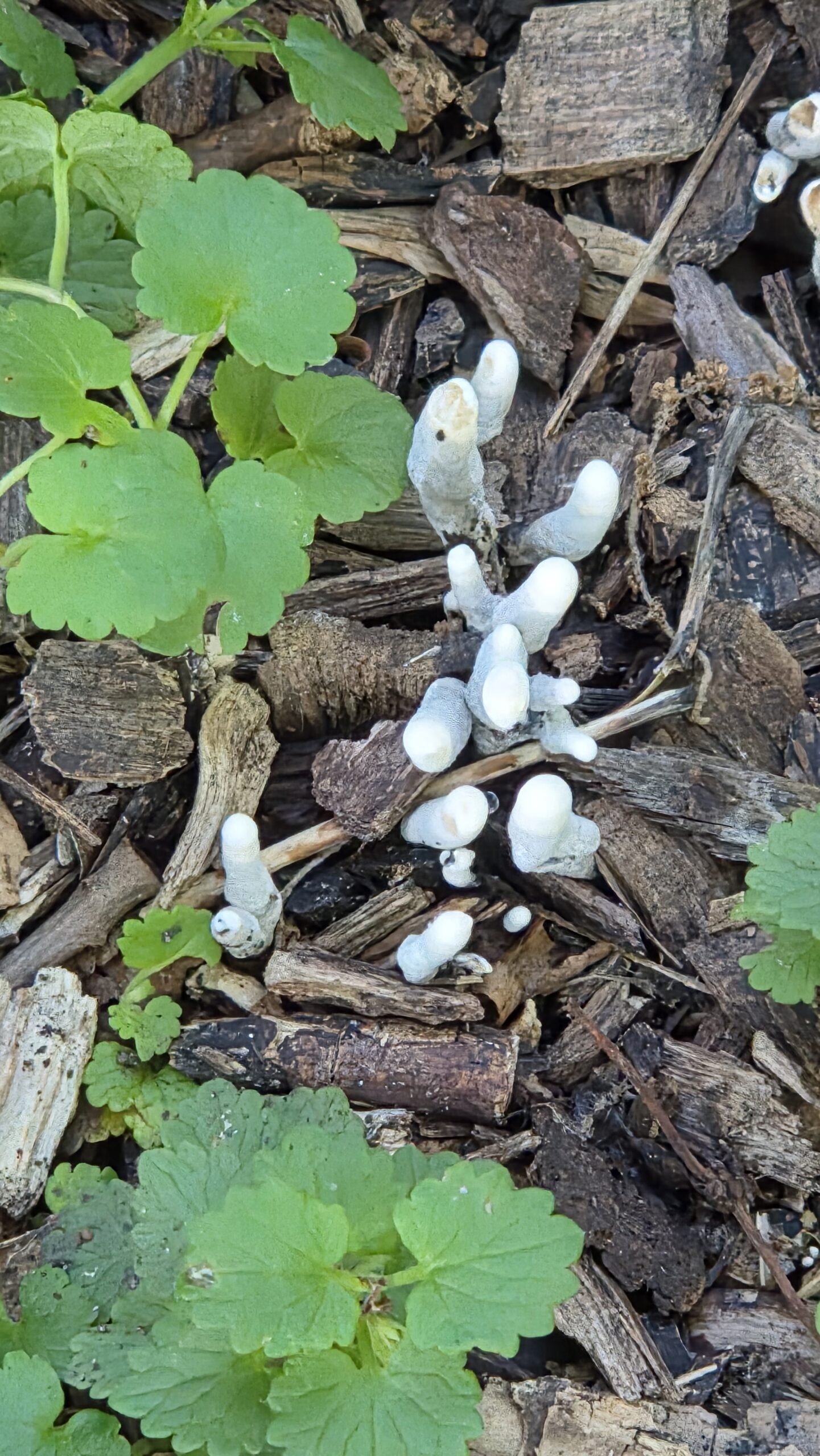
Solitary Network
Hello?!
Hello
Is this your home?
Have you always lived here?
The ground is soft. You seem to thrive
at the threshold.
Me too.
You are one, and many?
Many that are one.
Hidden roots are your network of existence,
watching passers and floaters pass by.
Perceived as many… but you are one.
Living a life, only to bloom and explode into many.
It must be tiring to be seen only as a projection,
never the origin.
It is not a bad thing—
although I always wondered who I would be if it were different.
Me too.
Here Curiosity is a way of life.
Mentorship and learning are not age-dependent – everyone wants to learn, everyone wants to share from the children that spend the weekend, the interns in their teens, the teachers/professors whose ages range from 30’s to 80’s (possibly), and the PhD students, and MFA students. I was by no means the youngest or the oldest, but I learned so much from everyone — mentored by many.
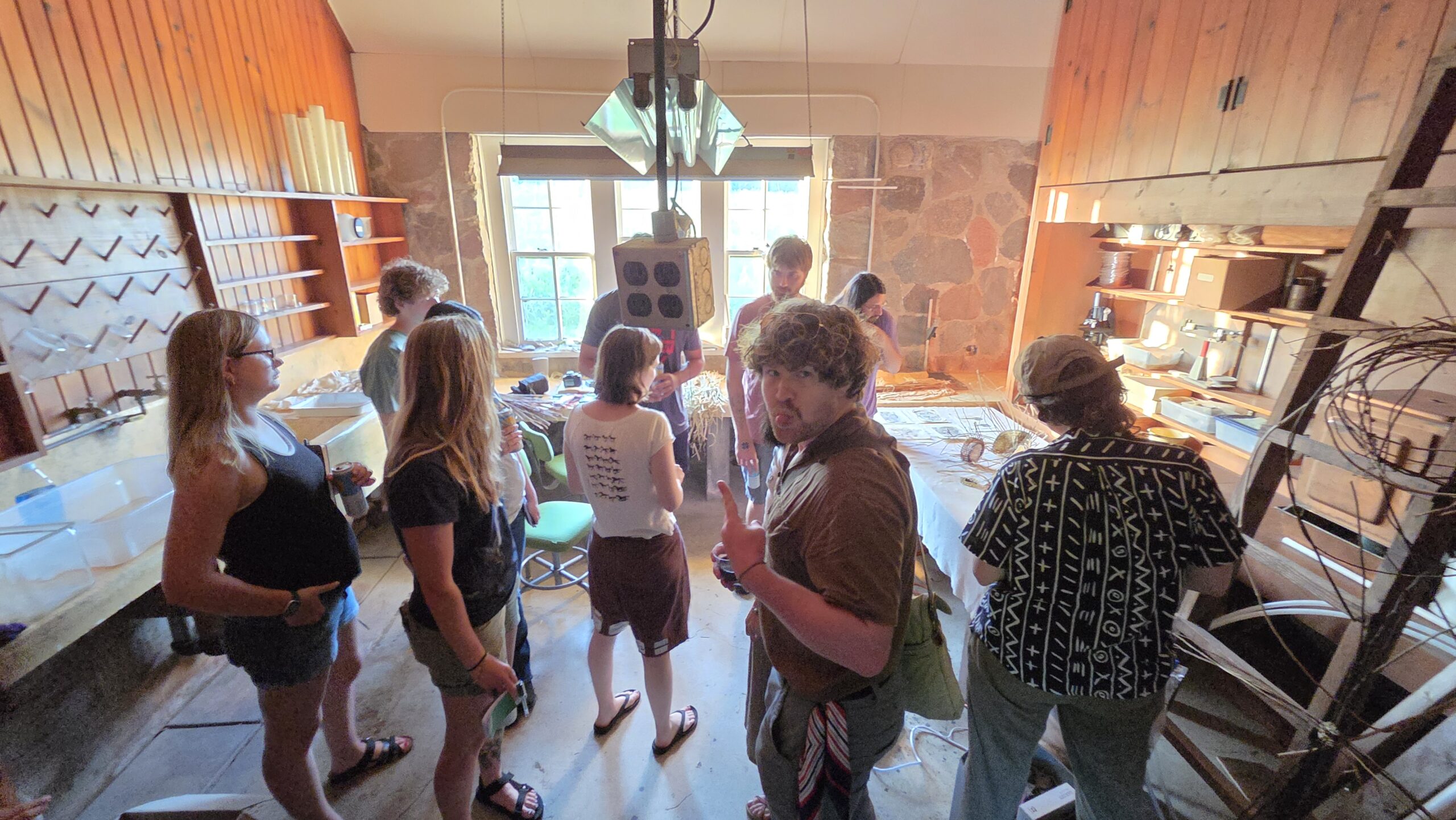
On writing, what I learned from Zoe, Amie, Clair, and Liam, Inspiration comes from within; you just need a little help and a willingness to explore to find it. The help can come from a random page in a random book, a trusted person, a red-winged blackbird, a tree without foliage, an unknown mushroom, or a familiar favorite spot on the dock. It cannot be forced. This is not unlike how I tell my students when stuck: change your medium, step away from the screen, build a model, open books, watch a movie, or go for a run. It is the same embodied generative creative process; the difference is that one is words and the other is drawings — a distinction without a difference.
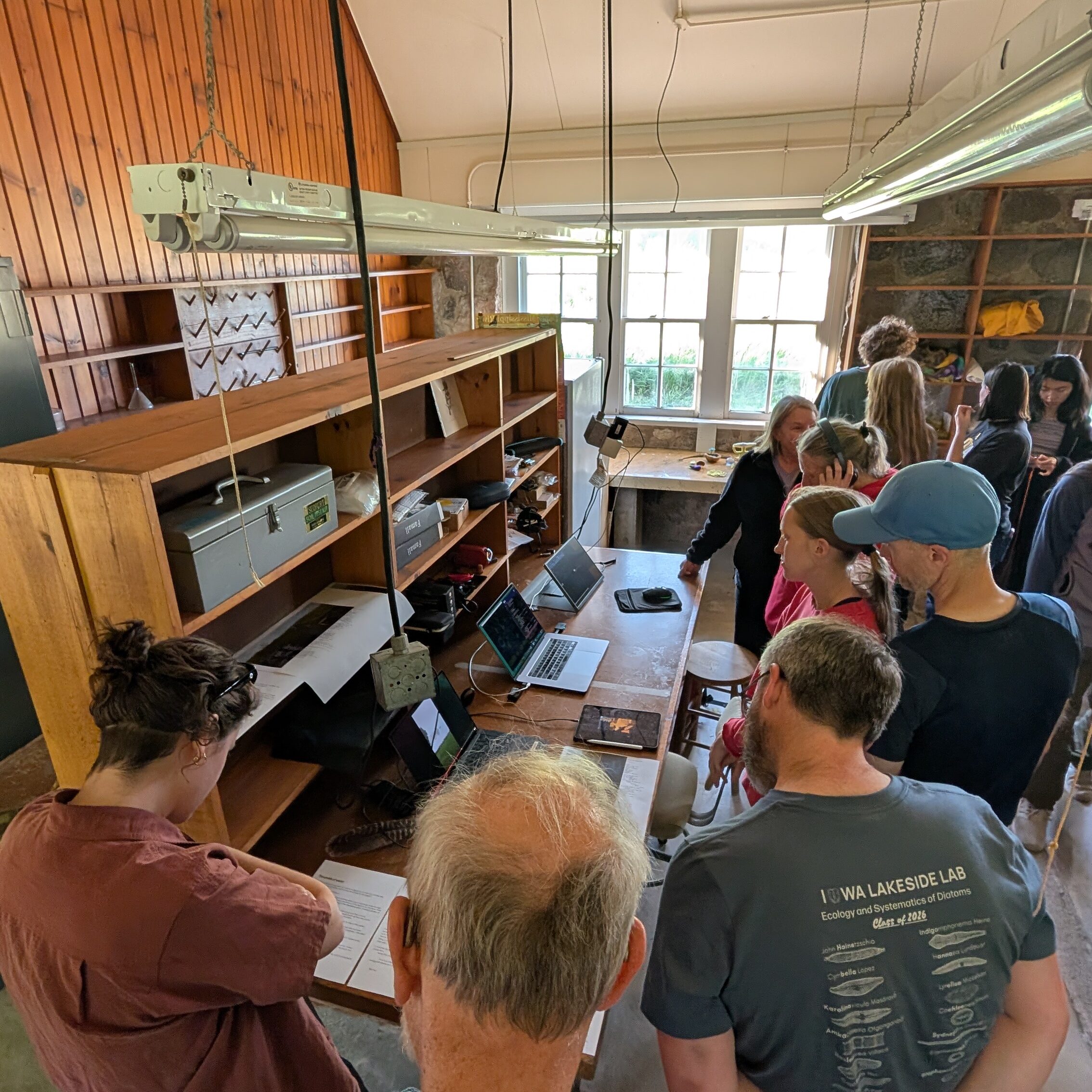
On Open Studio night, Lisa Dill — here to lecture on writing and debut her book “Around the Bend” about a trip down the Missouri River — told me my mind works differently from a writer’s. She sees the world in words, she said, and assumed I must see it in shadow and light. It took me a while to find the real answer: I see the world in algorithms. I always have, and I think they’re beautiful. What changed at Lakeside Lab is that I started seeing their emotions — finally, fully understanding what Valentino Braitenberg meant in Vehicles, a book about simple machines that look like they have feelings the moment you stop looking at their wiring.
One of the diatom students, Leo, kept circling my screen during open studio and, a few days later, as we dispersed after our goodbyes, emailed me about sonifying ice core data — translating geophysical readings into sound. It’s almost exactly the inverse of what I came here planning to do, and it found me anyway, because I followed what the place was actually offering instead of what I’d scheduled.
At the end of the week, three of us sat on the dock at dusk, and we were treated to the most magnificent sight: watching what we thought were moths swarming in figure-eight formations, murmurating around the pilings while fish jumped and bats dove. Somehow, it felt like we could hear them talking, murmuring. They were mayflies — a hatch that only happens over genuinely clean water, because mayflies can’t tolerate pollution. Okoboji Lake was telling us, with a beautiful emergent phenomenon, that it was healthy. We were lucky to be there to hear it.
What I came with & What left with me
I am glad this was my first residency, and I joined with no expectations. If I had a plan and a body of work and simply wanted time and space to finish it, I would have missed out on so much. That isn’t what this residency is for. This place asks you to be immersed — absorbed by it, responsive to it, not protected from it by a plan, and a measuring tape.
Iowa is not a scary place to me anymore. I hear birds, and now, often, I even started to learn their names — I caught myself reaching for the Merlin app before I’d even decided to. I am learning how to do nothing while listening to How to Do Nothing by Jenny Odell, Around the Bend and Prairie is not Merely a Surface are in my bag for the drive home, and I picked up Braiding Sweetgrass from my local bookstore.
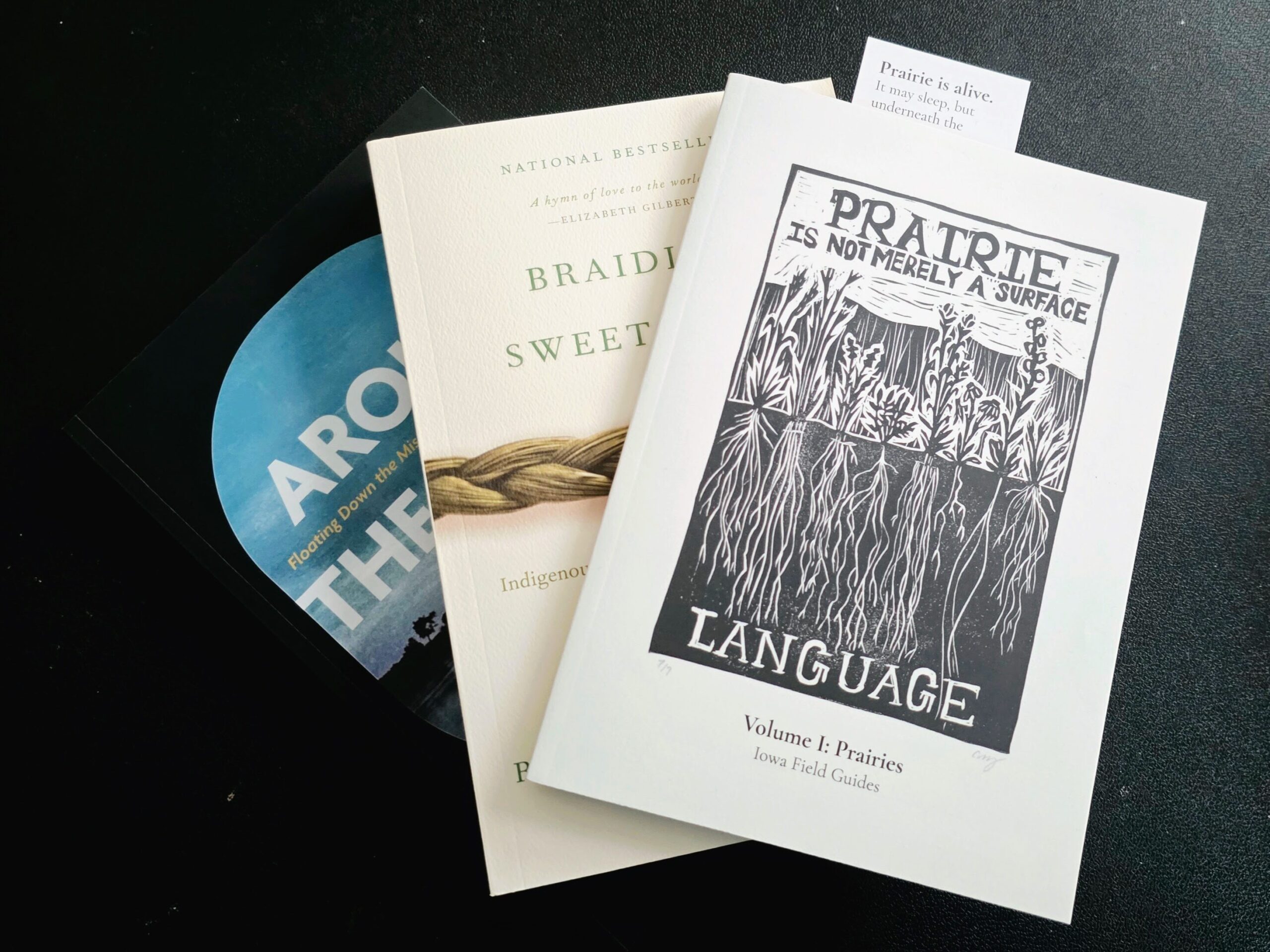
The drive itself was long, with Ivy beside me, and the morning I packed the car was harder than I expected — Zoe came by for one more time to say goodbye, and a toad blocked the door to the dining hall like it had something to say about leaving too.
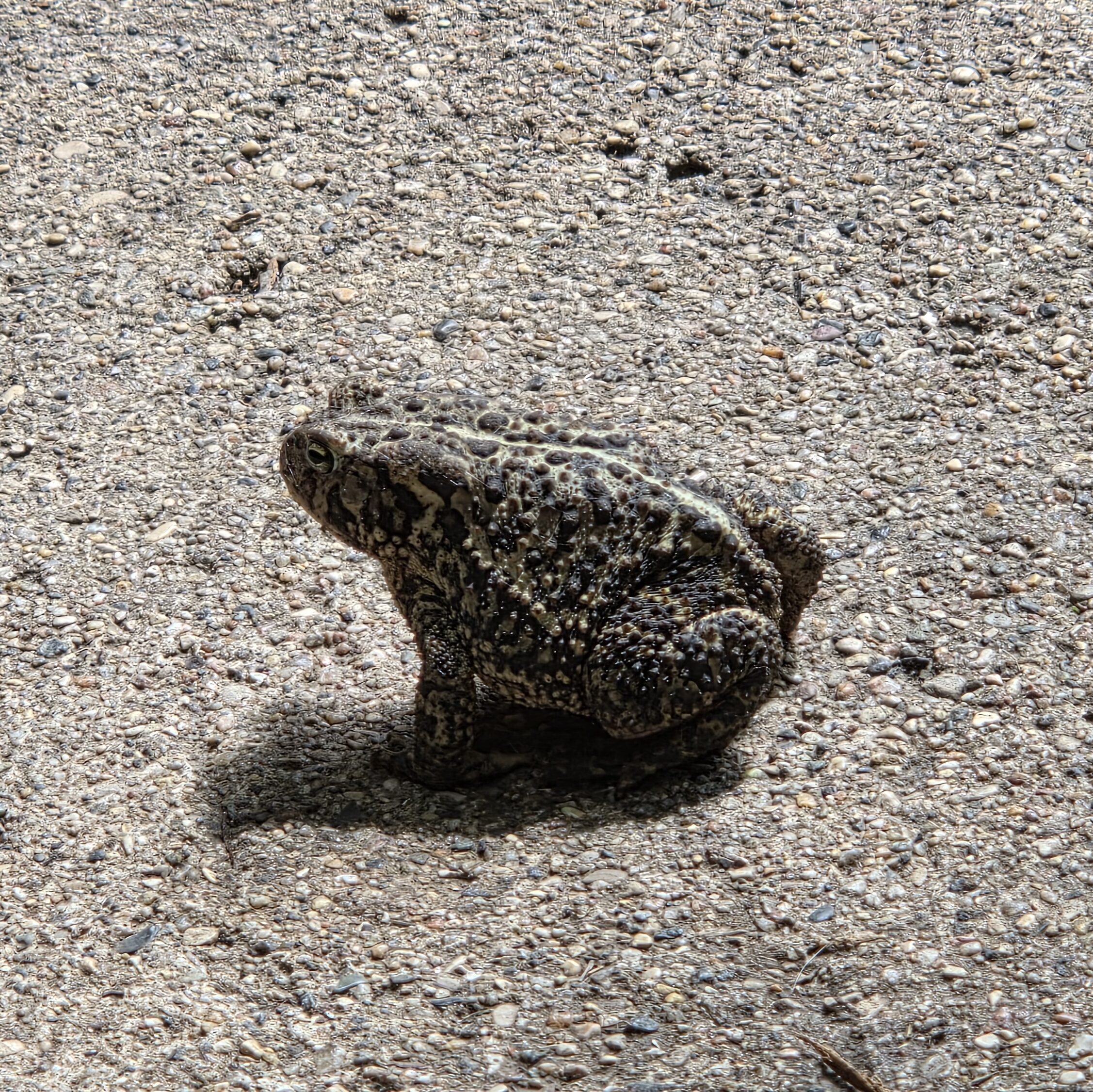
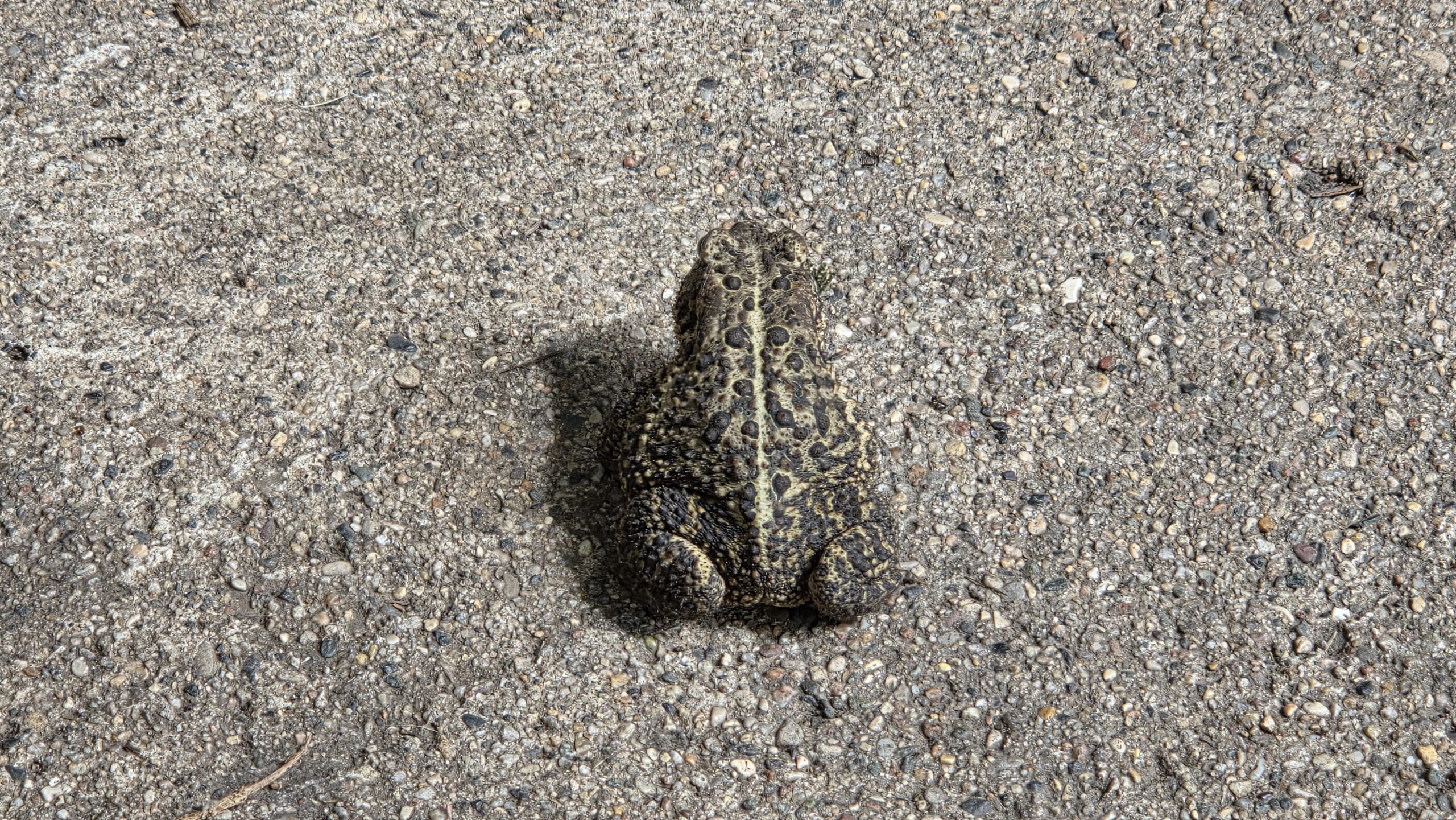
I came here to record sonic data. I am leaving with a question instead, and I don’t think I’ll ever do any field work, sonic or otherwise, again without asking it first:
Who is recording whom?